| Power System Blockset | Search Help Desk |
| Diode | Examples See Also |
Library
Power Electronics LibraryDescription
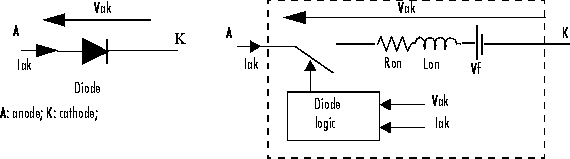
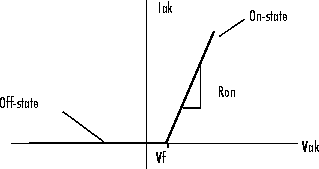
The Diode block also contains a series Rs-Cs snubber circuit, which is usually connected in parallel with the diode.The static VI characteristic of this model is shown in the figure below.
Dialog Box
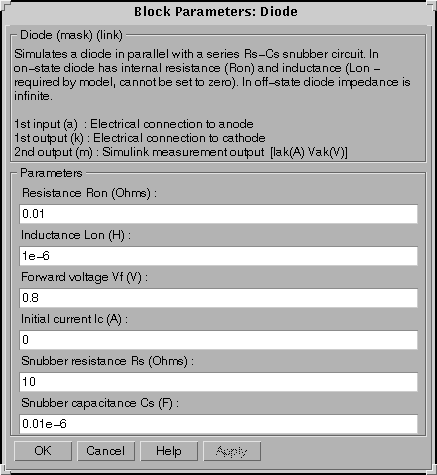
Because of modeling constraints explained in the Assumptions and Limitations section, the inductance Lon cannot be set to zero. You can specify a snubber which is purely resistive (Cs = Inf) or purely capacitive (Rs=0). If you specify either Rs=Inf or Cs=0, the snubber is eliminated and it disappears on the diode icon.
Inputs and Outputs
The first input and output are the diode terminals connected respectively to the anode (a) and the cathode (k). The second output (m) is a Simulink measurement output vector [Iak, Vak] returning the diode current and voltage.Assumptions and Limitations
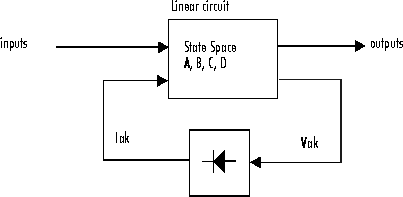
The Diode block implements a macro-model of the diode. It does not take into account either the geometry of the device or the complex physical processes underlying the state change [1]. The leakage current in the blocking state and the reverse-recovery (negative) current are not considered. In most circuits, the reverse current does not affect converter or other device characteristics. The diode is modeled as a nonlinear element interfaced with the linear circuit, as shown below.To avoid an algebraic loop in the Simulink representation, the diode inductance Lon cannot be set to zero. Each diode adds an extra state to the electrical circuit model. As the diode is modeled as a current source, it cannot be connected in series with an inductor, a current source, or an open circuit, unless a snubber circuit is used.
You must use a stiff integrator algorithm to simulate circuits containing diodes.ode23tb and ode15s usually give best simulation speed.
Example
Single pulse rectifier consisting of a diode, RL load, and AC source.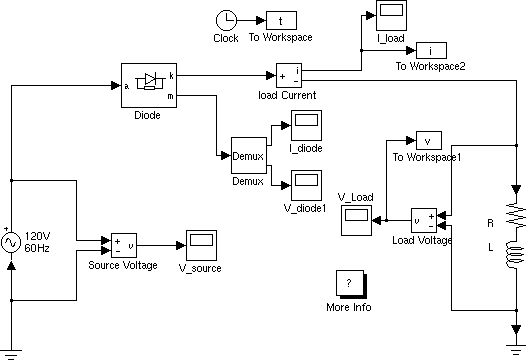
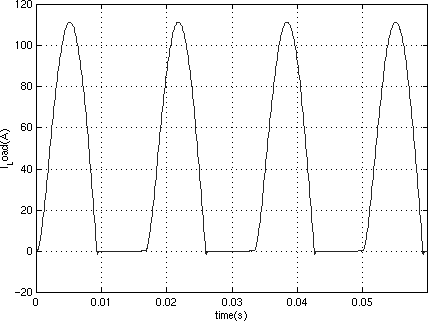
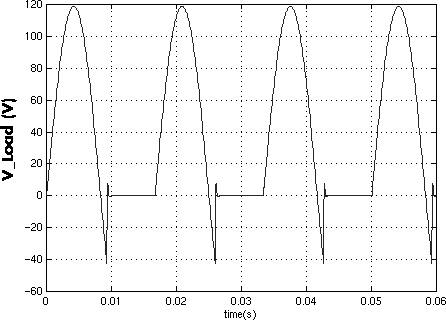
This circuit is available in the psbdiode.mdl file. Simulation produces the following results.
References
[1] Rajagopalan V., Computer-Aided Analysis of Power Electronic Systems, Marcel Dekker, Inc., New York, 1987. [2] Mohan N., Power Electronic, Converters, Applications and Design, John Wiley & Sons, Inc., New York, 1995.See Also
Thyristor, Mosfet, GTO, Ideal Switch