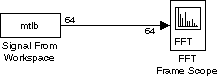
mtlb signal imported from the workspace in the model below has an actual sample period of 1/Fs = 1/7418.
| DSP Blockset | Search Help Desk |
| FFT Frame Scope | See Also |
Compute and display the frequency content of a frame-based input.
Library
DSP SinksDescription
The FFT Frame Scope block displays the magnitude of the FFT of the input, which is assumed to be a frame of sequential time-samples. The FFT length parameter, Nfft, specifies the number of samples on which to perform the FFT. A value of-1 instructs the block to use the input frame size as the FFT size, in which case you can also set the Sample time of original time-series parameter to -1 (see below). Otherwise, the block zero pads or truncates the input to Nfft before computing the FFT.
In order to correctly scale the frequency axis (i.e., to determine the frequencies against which the transformed input data should be plotted), the block needs to know the actual sample period of the time-domain sequence. The Sample time of original time-series parameter allows you to specify this in two different ways:
Auto-Detect from Input Sample Period.
A value of -1 for this parameter instructs the block to compute the frequency data from the sample period of the input. This parameter setting is appropriate if the FFT is computed on the same number of points as are contained in the time-domain input (i.e., no zero-padding or truncation). This is only true when the FFT size parameter is set to the size of the input (or, equivalently, to -1).
The auto-detect mode also makes the following two assumptions:
mtlb signal imported from the workspace in the model below has an actual sample period of 1/Fs = 1/7418.
Although the Sample time parameter in the Signal From Workspace block can legitimately be set to any value, for the auto-detect mode to compute the correct frequency scaling, the Sample time parameter must be set to the original sample period of 1/7418.
 /(NfftTs).
Note that all of the FFT-based blocks in the DSP Blockset, including those in the Power Spectrum Estimation library, compute the FFT at frequencies in the range [0,Fs). The Frequency range parameter controls only the displayed range of the signal.
The scope updates the display for each new input. The input can be an M-by-N frame matrix, where each of the N frames in the matrix contains M sequential time samples from an independent signal channel. The Number of input channels parameter specifies the number of independent channels (columns), N, in the matrix. The block overlays a separate FFT plot for each of the N independent channels in the input.
For information about the scope window, as well as the Axis properties and Line properties panels in the dialog box, see the reference page for the Time Frame Scope block.
/(NfftTs).
Note that all of the FFT-based blocks in the DSP Blockset, including those in the Power Spectrum Estimation library, compute the FFT at frequencies in the range [0,Fs). The Frequency range parameter controls only the displayed range of the signal.
The scope updates the display for each new input. The input can be an M-by-N frame matrix, where each of the N frames in the matrix contains M sequential time samples from an independent signal channel. The Number of input channels parameter specifies the number of independent channels (columns), N, in the matrix. The block overlays a separate FFT plot for each of the N independent channels in the input.
For information about the scope window, as well as the Axis properties and Line properties panels in the dialog box, see the reference page for the Time Frame Scope block.
Dialog Box
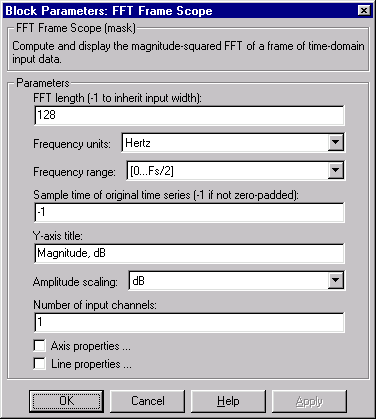
-1 sets the FFT length to the input frame size.


-1 to auto-detect the signal sample period from the frame period and frame size of the block input (use only when the FFT size is equal to the size of the input or -1).
See Also
Buffered FFT Frame Scope