| DSP Blockset | Search Help Desk |
Filter Designs Blocks
Each block in the Filter Designs library accepts high-level filter specifications as its parameters. Based on these specifications, the block designs the appropriate filter when you close the dialog box, so that the frequency response plot on the icon matches the filter specifications. The block saves the filter coefficients and applies the filter to the input data. In each case, the block's output is the filtered time-sequence. The Filter Designs library contains six blocks, which can be grouped into three categories:The Digital FIR Filter Design and Digital IIR Filter Design blocks design and implement discrete-time filters with standard band configurations (highpass, lowpass, bandpass, or bandstop). These are classical IIR and linear phase FIR filters, with Butterworth, Chebyshev type I, Chebyshev type II, and elliptic designs.
The Analog Filter Design block designs and implements Butterworth, Chebyshev type I, Chebyshev type II, and elliptic filters in standard band configurations.
The Remez FIR Filter Design, Yule-Walker IIR Filter Design, and Least Squares FIR Filter Design blocks design and implement IIR or FIR filters with arbitrary magnitude responses, including multiband responses.
Frame-Based Processing
All of the discrete-input blocks provide frame-based processing capability. This means that the blocks can simultaneously apply the designed filter to multiple channels of a frame-based signal. Multichannel frame-based signals are represented in matrix form, as described in "Understanding Matrices" and "Understanding Samples and Frames" in Chapter 2 The figure below shows an example of a four-channel frame matrix.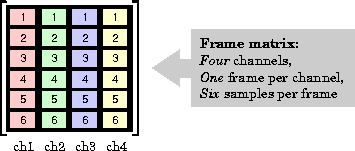 Each column in the above matrix is an independent signal channel containing six sequential samples (numbered 1 to 6 in the figure above). The four samples in each row all correspond to the same sample instant: The first row,
 u(1,:), contains the earliest set of samples; the last row, u(6,:), contains the newest set of samples. The filter design blocks apply the specified filter independently to the signal data in each channel. The output is a 6-by-4 matrix containing the four independently filtered signal channels.