DSP Blockset
  Go to block:
    Search    Help Desk 
Digital IIR Filter Design    See Also

Design and implement an IIR filter.

Library

Filter Designs, in Filtering

Description

The Digital IIR Filter Design block designs a discrete-time (digital) IIR filter in a lowpass, highpass, bandpass, or bandstop configuration, and applies the filter to the input using the Direct-Form II Transpose Filter block in the Filter Realizations library. The Design method parameter allows you to specify Butterworth, Chebyshev type I, Chebyshev type II, and elliptic filter designs. Note that for the bandpass and bandstop configurations, the actual filter length is twice the Filter order parameter value.

Filter Design
Description
Butterworth
The magnitude response of a Butterworth filter is maximally flat in the passband and monotonic overall.

Chebyshev type I
The magnitude response of a Chebyshev type I filter is equiripple in the passband and monotonic in the stopband.

Chebyshev type II
The magnitude response of a Chebyshev type II filter is monotonic in the passband and equiripple in the stopband.
Elliptic
The magnitude response of an elliptic filter is equiripple in both the passband and the stopband.

The design and band configuration of the filter are selected from the Design method and Filter type pop-up menus in the dialog box. For each combination of design method and band configuration, an appropriate set of secondary parameters is displayed.

The table below lists the available parameters for each design/band combination. For lowpass and highpass band configurations, these parameters include the passband edge frequency fnp, the stopband edge frequency fns, the passband ripple Rp, and the stopband attenuation Rs. For bandpass and bandstop configurations, the parameters include the lower and upper passband edge frequencies, fnp1 and fnp2, the lower and upper stopband edge frequencies, fns1 and fns2, the passband ripple Rp, and the stopband attenuation Rs. Frequency values are normalized to the Nyquist frequency, and ripple and attenuation values are in dB.


Lowpass
Highpass
Bandpass
Bandstop
Butterworth
Order, fnp
Order, fnp
Order, fnp1, fnp2
Order, fnp1, fnp2
Chebyshev Type I
Order, fnp, Rp
Order, fnp, Rp
Order, fnp1, fnp2, Rp
Chebyshev Type II
Order, fns, Rs
Order, fns, Rs
Order, fns1, fns2, Rs
Elliptic
Order, fnp, Rp, Rs
Order, fnp, Rp, Rs
Order, fnp1, fnp2, Rp, Rs

The digital filters are designed using the Signal Processing Toolbox's filter design commands butter, cheby1, cheby2, and ellip.

The Frame-based inputs parameter allows you to choose between sample-based and frame-based operation.

Sample-Based Operation

When the check box is not selected (default), the block assumes that the input is a 1-by-N sample vector or M-by-N sample matrix. Each of the N vector elements (or M*N matrix elements) is treated as an independent channel, and the block filters each channel over time.

Frame-Based Operation

When the Frame-based inputs check box is selected, the block assumes that the input is an M-by-N frame matrix. Each of the N frames in the matrix contains M sequential time samples from an independent signal. The Number of channels parameter specifies the number of independent channels (columns), N, in the matrix. The block filters each channel independently over time. Frame-based operation provides substantial increases in throughput rates, at the expense of greater model latency.

In both sample-based and frame-based modes, the output is the same size as the input.

Dialog Box

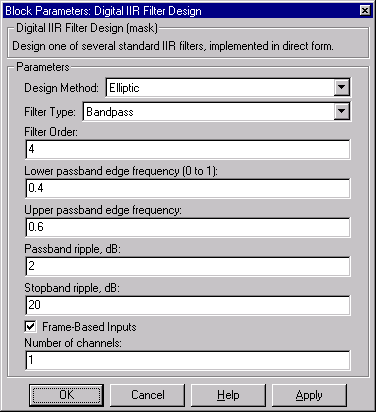
The parameters displayed in the dialog box vary for different design/band combinations. Not all of the parameters shown above (and listed below) are visible in the dialog box at any one time.

Design method
The filter design method: Butterworth, Chebyshev type I, Chebyshev type II, or Elliptic.
Filter type
The type of filter to design: Lowpass, Highpass, Bandpass, or Bandstop.
Filter order
The order of the filter for lowpass and highpass configurations. For bandpass and bandstop configurations, the length of the final filter is twice this value.
Passband edge frequency
The normalized passband edge frequency for the highpass and lowpass configurations of the Butterworth, Chebyshev type I, and elliptic designs.
Lower passband edge frequency
The normalized lower passband frequency for the bandpass and bandstop configurations of the Butterworth, Chebyshev type I, and elliptic designs.
Upper passband edge frequency
The normalized upper passband frequency for the bandpass and bandstop configurations of the Butterworth, Chebyshev type I, or elliptic designs.
Stopband edge frequency
The normalized stopband edge frequency for the highpass and lowpass band configurations of the Chebyshev type II design.
Lower stopband edge frequency
The normalized lower stopband frequency for the bandpass and bandstop configurations of the Chebyshev type II design.
Upper stopband edge frequency
The normalized upper stopband frequency for the bandpass and bandstop filter configurations of the Chebyshev type II design.
Passband ripple
The passband ripple, in dB, for the Chebyshev type I and elliptic designs.
Stopband ripple
The stopband attenuation, in dB, for the Chebyshev type II and elliptic designs.
Frame-based inputs
Selects frame-based operation.
Number of channels
For frame-based operation, the number of columns (channels) in the input matrix.

References

Antoniou, A. Digital Filters: Analysis, Design, and Applications. 2nd ed. New York, NY: McGraw-Hill, 1993.

Oppenheim, A. V. and R. W. Schafer. Discrete-Time Signal Processing. Englewood Cliffs, NJ: Prentice Hall, 1989.

Proakis, J. and D. Manolakis. Digital Signal Processing. 3rd ed. Englewood Cliffs, NJ: Prentice-Hall, 1996.

See Also

Digital FIR Filter Design
Yule-Walker IIR Filter Design
butter (Signal Processing Toolbox)
cheby1 (Signal Processing Toolbox)
cheby2 (Signal Processing Toolbox)
ellip (Signal Processing Toolbox)


[ Previous | Help Desk | Next ]