| DSP Blockset | Search Help Desk |
| Yule-Walker IIR Filter Design | See Also |
Design and apply an IIR filter.
Library
Filter Designs, in FilteringDescription
The Yule-Walker IIR Filter Design block designs a recursive (ARMA) digital filter with arbitrary multiband magnitude response. The filter design, which uses theyulewalk function in the Signal Processing Toolbox, performs a least-squares fit to the specified frequency response.
The Band-edge frequency vector parameter is a vector of frequency points in the range 0 to 1, where 1 corresponds to half the sampling frequency (the Nyquist frequency). The first element of this vector must be 0 and the last element 1, and intermediate points must appear in ascending order. The Magnitudes at these frequencies parameter is a vector containing the desired magnitude response at the points specified in the Band-edge frequency vector.
Note that, unlike the Remez FIR Filter Design block, each frequency-magnitude pair specifies the junction of two adjacent frequency bands, so there are no "transition" regions.
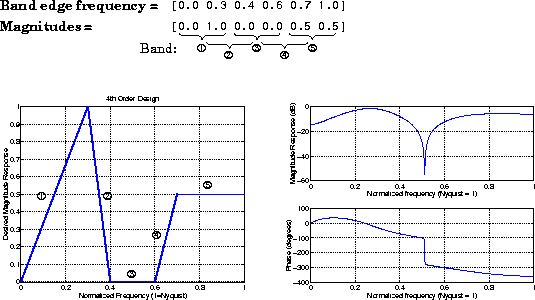
When specifying the Band-edge frequency vector and Magnitudes at these frequencies vectors, avoid excessively sharp transitions from passband to stopband. You may need to experiment with the slope of the transition region to get the best filter design.
For more details on the Yule-Walker filter design algorithm, see the description of theyulewalk function in the Signal Processing Toolbox User's Guide.
The Frame-based inputs parameter allows you to choose between sample-based and frame-based operation.
Sample-Based Operation
When the check box is not selected (default), the block assumes that the input is a 1-by-N sample vector or M-by-N sample matrix. Each of the N vector elements (or M*N matrix elements) is treated as an independent channel, and the block filters each channel over time.Frame-Based Operation
When the Frame-based inputs check box is selected, the block assumes that the input is an M-by-N frame matrix. Each of the N frames in the matrix contains M sequential time samples from an independent signal. The Number of channels parameter specifies the number of independent channels (columns, N) in the matrix, and the block filters each channel independently over time. Frame-based operation provides substantial increases in throughput rates, at the expense of greater model latency. In both sample-based and frame-based operation, the output is the same size as the input.Dialog Box
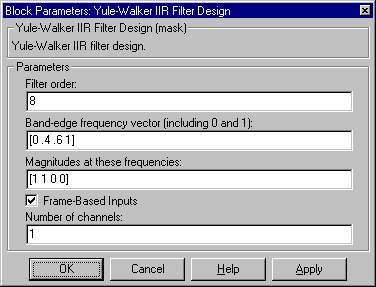
1 corresponds to the Nyquist frequency. The first element of this vector must be 0 and the last element 1.References
Oppenheim, A. V. and R. W. Schafer. Discrete-Time Signal Processing. Englewood Cliffs, NJ: Prentice Hall, 1989. Proakis, J. and D. Manolakis. Digital Signal Processing. 3rd ed. Englewood Cliffs, NJ: Prentice-Hall, 1996.See Also
Digital IIR Filter Designyulewalk (Signal Processing Toolbox)