
| Signal Processing Toolbox | Search Help Desk |
| cheby1 | Examples See Also |
Chebyshev type I filter design (passband ripple).
Syntax
[b,a] = cheby1(n,Rp,Wn)
[b,a] = cheby1(n,Rp,Wn,'ftype')
[b,a] = cheby1(n,Rp,Wn,'s')
[b,a] = cheby1(n,Rp,Wn,'ftype','s')
[z,p,k] = cheby1(...)
[A,B,C,D] = cheby1(...)
Description
cheby1 designs lowpass, bandpass, highpass, and bandstop digital and analog Chebyshev type I filters. Chebyshev type I filters are equiripple in the passband and monotonic in the stopband. Type I filters roll off faster than type II filters, but at the expense of greater deviation from unity in the passband.
Digital Domain
[b,a] = cheby1(n,Rp,Wn)
designs an order n Wn and Rp dB of ripple in the passband. It returns the filter coefficients in the length n+1 row vectors b and a, with coefficients in descending powers of z:
-Rp dB. For cheby1, the cutoff frequency Wn is a number between 0 and 1, where 1 corresponds to half the sampling frequency (the Nyquist frequency). Smaller values of passband ripple Rp lead to wider transition widths (shallower rolloff characteristics).
If Wn is a two-element vector, Wn = [w1 w2], cheby1 returns an order 2*n bandpass filter with passband w1 < 
< w2.
[b,a] = cheby1(n,Rp,Wn,'ftype')
designs a highpass or bandstop filter, where ftype is
high for a highpass digital filter with cutoff frequency Wn
stop for an order 2*n bandstop digital filter if Wn is a two-element vector, Wn = [w1 w2]
The stopband is w1 <  <
< w2.
cheby1 directly obtains other realizations of the filter. To obtain zero-pole-gain form, use three output arguments:
[z,p,k] = cheby1(n,Rp,Wn)
or
[z,p,k] = cheby1(n,Rp,Wn,'ftype')
returns the zeros and poles in length n column vectors z and p and the gain in the scalar k.
To obtain state-space form, use four output arguments:
[A,B,C,D] = cheby1(n,Rp,Wn)
or
[A,B,C,D] = cheby1(n,Rp,Wn,'ftype')
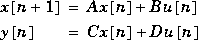
where A, B, C, and D are
Analog Domain
[b,a] = cheby1(n,Rp,Wn,'s')
n Wn. It returns the filter coefficients in length n + 1 row vectors b and a, in descending powers of s:

-Rp dB. For cheby1, the cutoff frequency Wn must be greater than 0.
If Wn is a two-element vector, Wn = [w1 w2], with w1 < w2, then cheby1(n,Rp,Wn,'s') returns an order 2*n bandpass analog filter with passband w1 < < w2.
[b,a] = cheby1(n,Rp,Wn,'ftype','s')
designs a highpass or bandstop filter, where ftype is
high for a highpass analog filter with cutoff frequency Wn
stop for an order 2*n bandstop analog filter if Wn is a two-element vector, Wn = [w1 w2]
The stopband is w1 < < w2.
[z,p,k] = cheby1(n,Rp,Wn,'s')
or
[z,p,k] = cheby1(n,Rp,Wn,'ftype','s')
returns the zeros and poles in length n or 2*n column vectors z and p and the gain in the scalar k.
To obtain state-space form, use four output arguments:
[A,B,C,D] = cheby1(n,Rp,Wn,'s')
or
[A,B,C,D] = cheby1(n,Rp,Wn,'ftype','s')
where A, B, C, and D are defined as

Examples
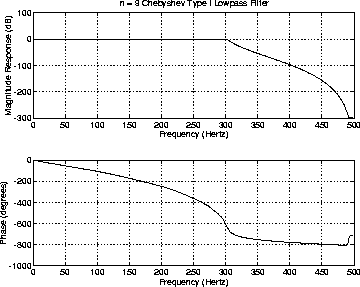
For data sampled at 1000 Hz, design a 9th-order lowpass Chebyshev type I filter with 0.5 dB of ripple in the passband and a cutoff frequency of 300 Hz:[b,a] = cheby1(9,0.5,300/500);The frequency response of the filter is
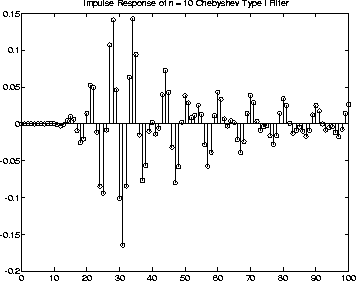
freqz(b,a,512,1000)Design a 10th-order bandpass Chebyshev type I filter with a passband from 100 to 200 Hz and plot its impulse response:
n = 10; Rp = 0.5;
Wn = [100 200]/500;
[b,a] = cheby1(n,Rp,Wn);
[y,t] = impz(b,a,101); stem(t,y)
Limitations
For high order filters, the state-space form is the most numerically accurate, followed by the zero-pole-gain form. The transfer function form is the least accurate; numerical problems can arise for filter orders as low as 15.Algorithm
cheby1 uses a five-step algorithm:
cheb1ap function.
cheby1 uses bilinear to convert the analog filter
into a digital filter through a bilinear transformation with frequency
prewarping. Careful frequency adjustment guarantees that the analog
filters and the digital filters will have the same frequency response
magnitude at Wn or w1 and w2.
See Also
besself |
Bessel analog filter design. |
butter |
Butterworth analog and digital filter design. |
cheb1ap |
Chebyshev type I analog lowpass filter prototype. |
cheb1ord |
Chebyshev type I filter order selection. |
cheby2 |
Chebyshev type II filter design (stopband ripple). |
ellip |
Elliptic (Cauer) filter design. |