| DSP Blockset | Search Help Desk |
Understanding Samples and Frames
In DSP Blockset models, vectors and matrices are often used to group scalar signal samples. For example, a length-N vector may represent a snapshot of the readings from N thermocouples. Similarly, an M-by-N matrix might represent the brightness values of an M-by-N array of pixels at a particular instant in time. In each case, the vector or matrix is used to bundle scalar samples together in a single, convenient unit.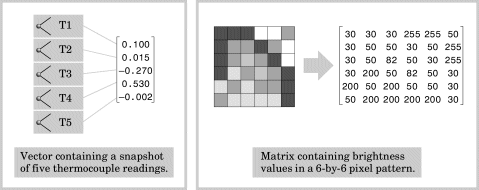
The scalar samples in a vector or matrix may come from multiple independent signals (as shown above) or from a single signal, like the speech segment shown below.
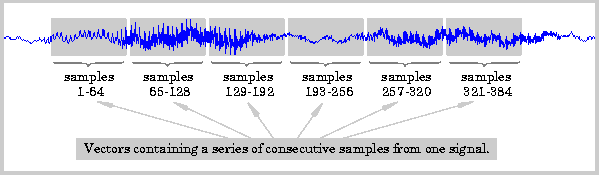
When the scalar samples come from several independent signals, and all correspond to the same instant in time, the vector or matrix is referred to as a sample vector or sample matrix. When the scalar samples come from a single signal, and correspond to sequential points in time, the vector or matrix is referred to as a frame vector or frame matrix. A sequence of sample vectors or sample matrices is called a sample-based sequence, while a sequence of frames or frame matrices is called a frame-based sequence.
Note