1 effectively disables averaging.


 parameter for the Kaiser window. Disabled for other Window type selections. Increasing Beta widens the mainlobe and decreases the amplitude of the window sidelobes in the window's frequency magnitude response.
| DSP Blockset | Search Help Desk |
| Short-Time FFT | See Also |
Compute a nonparametric estimate of the spectrum using the short-time, fast Fourier transform (ST-FFT) method.
Library
Power Spectrum Estimation, in EstimationDescription
The Short-Time FFT block computes a nonparametric estimate of the spectrum. The block averages the squared magnitude of the FFT computed over windowed sections of the input, and normalizes the spectral average by the square of the sum of the window samples. The block accepts an M-by-N frame matrix input, where each of the N frames in the matrix contains M sequential time samples from an independent signal. The Number of channels parameter specifies the number of independent channels, N, in the matrix. A value of 1 for Number of channels specifies a single channel (vector) input. The block computes a separate estimate for each of the N independent channels in the input, generating an Nfft-by-N matrix output, where Nfft is specified as a power of 2 by the FFT Size parameter. A value of-1 for FFT size instructs the block to use the input frame size as the FFT size. Otherwise, the block zero pads or truncates the input to Nfft before computing the FFT. Each column of the output matrix contains the estimate of the corresponding input column's power spectral density at Nfft equally spaced frequency points in the range [0,Fs), where Fs is the signal's sample frequency.
The Number of spectral averages specifies the number of spectra to average. Setting this parameter to 1 effectively disables averaging.
The Window type, Stopband ripple, Beta, and Window sampling parameters all apply to the specification of the window function; see the reference page for the Window Function block for more details on these four parameters.
Dialog Box
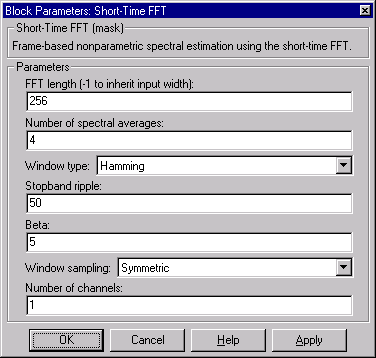
1 effectively disables averaging. parameter for the Kaiser window. Disabled for other Window type selections. Increasing Beta widens the mainlobe and decreases the amplitude of the window sidelobes in the window's frequency magnitude response. References
Oppenheim, A. V. and R. W. Schafer. Discrete-Time Signal Processing. Englewood Cliffs, NJ: Prentice Hall, 1989. Proakis, J. and D. Manolakis. Digital Signal Processing. 3rd ed. Englewood Cliffs, NJ: Prentice-Hall, 1996.See Also
Burg Methodpwelch (Signal Processing Toolbox)