| DSP Blockset | Search Help Desk |
| Burg Method | See Also |
Compute a parametric spectral estimate using the Burg method.
Library
Power Spectrum Estimation, in EstimationDescription
The Burg Method block estimates the power spectral density (PSD) of the input frame using the Burg method. This method fits an autoregressive (AR) model to the signal by minimizing (least-squares) the forward and backward prediction errors while constraining the AR parameters to satisfy the Levinson-Durbin recursion. The spectrum is then computed from the FFT of the estimated AR model parameters. The order of the all-pole model is specified by the Order parameter. The Burg Method and Yule-Walker Method blocks return similar results for large frame sizes. The input is a frame of consecutive time samples; a matrix input,u, is also treated as a single frame, u(:). The block's output is the estimate of the signal's power spectral density at Nfft equally spaced frequency points in the range [0,Fs), where Nfft is specified as a power of 2 by the FFT Size parameter and Fs is the signal's sample frequency. A value of -1 for FFT size instructs the block to use the input frame size as the FFT size. Otherwise, the block zero pads or truncates the input to Nfft before computing the FFT.
The following table compares the features of the Burg Method block to the Covariance Method, Modified Covariance Method, and Yule-Walker Method blocks.Dialog Box
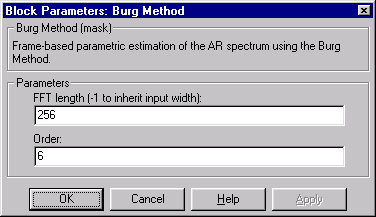
References
Kay, S. M. Modern Spectral Estimation: Theory and Application. Englewood Cliffs, NJ: Prentice-Hall, 1988. Orfanidis, J. S. Optimum Signal Processing: An Introduction. 2nd ed. New York, NY: Macmillan, 1985.See Also
Burg AR Estimatorpburg (Signal Processing Toolbox)