
| DSP Blockset | Search Help Desk |
| Chirp | See Also |
Generate a swept-frequency cosine.
Library
DSP SourcesDescription
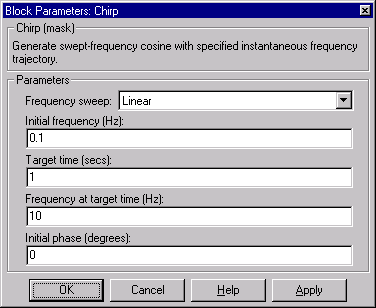
The Chirp block outputs a unity-amplitude swept-frequency cosine (chirp) signal. The frequency trajectory of the output signal is defined by two instantaneous frequency values. The instantaneous output frequency is initialized to the Initial frequency parameter value at the start of the simulation, and then varies continuously to the Frequency at target time parameter value. The transition between these two frequencies takes place over the period of time specified in the Target time parameter. The frequency trajectory established by these three parameters is maintained until the end of the simulation. That is, the frequency of the output (after the target time) continues to change according to the specified trajectory. Note that the output of this block is continuous. The method that the block uses to transition between the specified instantaneous frequencies is set by the Frequency sweep parameter, and can be Linear, Quadratic, or Logarithmic:
where f0 is the Initial frequency parameter value, and

 ensures that the desired Frequency at target time value, f1, occurs at the specified Target time, t1.

where


where

For the logarithmic sweep, the Frequency at target time parameter value must be greater than the Initial frequency parameter value.
Dialog Box


See Also
Signal From Workspacechirp (Signal Processing Toolbox)