Filter and downsample an input signal.
Library
Multirate Filters, in Filtering
Description
The FIR Decimation block resamples the input at an integer rate K times slower than the input sample rate, where K is specified by the Decimation factor parameter. This process consists of two steps:
The FIR Decimation block implements the FIR filtering and downsampling steps together using a polyphase filter structure, which is more efficient than straightforward filter-then-decimate algorithms. The output of the decimator is the first filter phase.
In practice, the filter specified by the FIR filter coefficients vector should be a lowpass FIR with normalized cutoff frequency no greater than 1/K. The coefficients in the vector are ordered in descending powers of z.
The Frame-based inputs parameter allows you to choose between sample-based and frame-based operation.
Sample-Based Operation
When the check box is not selected (default), the block assumes that the input is a 1-by-N sample vector or M-by-N sample matrix. Each of the N vector elements (or M*N matrix elements) is treated as an independent channel, and the block decimates each channel over time.
Frame-Based Operation
When the Frame-based inputs check box is selected, the block assumes that the input is an M-by-N frame matrix. Each of the N frames in the matrix contains M sequential time samples from an independent signal. The illustration below shows a 6-by-4 matrix input:
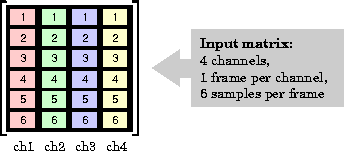
The Number of channels parameter specifies the number of independent channels (columns), N, in the matrix, and the block decimates each channel independently over time. Frame-based operation provides substantial increases in throughput rates, at the expense of greater model latency.
In frame-based operation, the Framing parameter determines how the block adjusts the rate at the output. There are two available options:
The block generates the output at the slower (decimated) rate by using a proportionally smaller frame size than the input. For decimation by a factor of K, the output frame size is K times smaller than the input frame size, but the input and output frame rates are equal. The input frame size must be a multiple of the decimation factor.
The example below shows a single-channel input of frame size 64 being decimated by a factor of 4 to a frame size of 16. The block's input and output frame rates are identical.

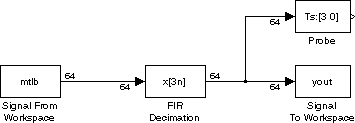
The block generates the output at the slower (decimated) rate by using a proportionally longer frame period at the output port than at the input port. For decimation by a factor of K, the output frame period is K times longer than the input frame period, but the input and output frame sizes are equal.
The example below shows a single-channel input (frame size = 64) with a sample period of 1 second being decimated by a factor of 3 to a sample period of 3 seconds. The input and output frame sizes are identical.
Note
If you expect to generate code for the FIR Decimation block using the Real-Time Workshop, you should ensure that inputs are contiguous in memory. See the Contiguous Copy block for more information.
Dialog Box
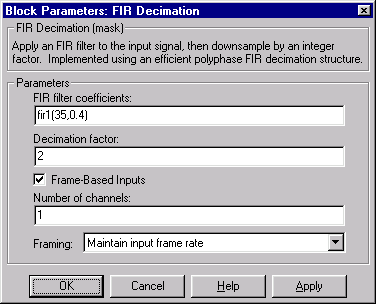
- FIR filter coefficients
- The FIR filter coefficients, in descending powers of z.
- Decimation factor
- The integer factor, K, by which to decrease the sample rate of the input sequence.
- Frame-based inputs
- Selects frame-based operation.
- Number of channels
- For frame-based operation, the number of columns (channels) in the input matrix, N.
- Framing
- For frame-based operation, the method by which to implement the decimation; reduce the output frame rate, or reduce the output frame size.
See Also
Downsample
FIR Interpolation
FIR Rate Conversion
decimate (Signal Processing Toolbox)
[ Previous | Help Desk | Next ]