
| DSP Blockset | Search Help Desk |
| FIR Rate Conversion | See Also |
Upsample, filter, and downsample an input signal.
Library
Multirate Filters, in FilteringDescription
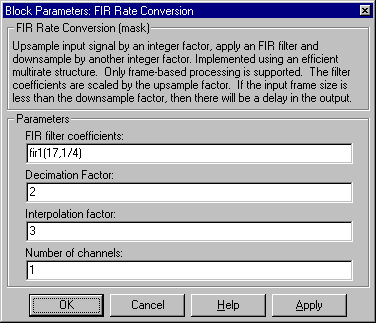
The FIR Rate Conversion block resamples the input to a period K/L times the input sample period, where K is specified by the Decimation factor parameter and L is specified by the Interpolation factor parameter. The resampling process consists of the following steps:min(1/L,1/K). The coefficients in the vector are ordered in descending powers of z.
Frame-Based Operation
This block always operates in frame-based mode, and expects an Mi-by-N frame matrix input. Each of the N frames in the matrix contains Mi sequential time samples from an independent signal. The illustration below shows a 6-by-4 matrix input: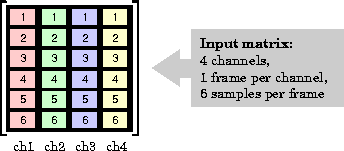
The Number of channels parameter specifies the number of independent channels (columns, N) in the matrix, and the block resamples each channel independently over time. Frame-based operation provides substantial increases in throughput rates, at the expense of greater model latency.
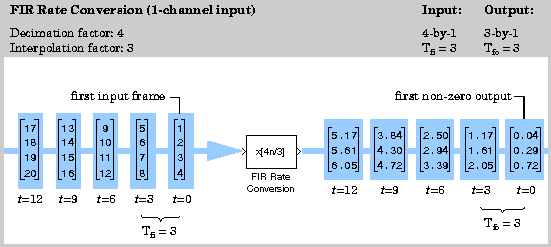
The Interpolation factor, L, and Decimation factor, K, must satisfy the relation
Diagnostics
An error is generated if the relation between K and L shown above is not satisfied.(Input port width)/(Output port width) must equal the (Decimation factor)/(Interpolation factor).A warning is generated if L and K are not relatively prime; that is, if the ratio L/K can be reduced to a ratio of smaller integers.
Warning: Integer conversion factors are not relatively prime in block 'The block scales the ratio to be relatively prime, and continues the simulation. Notemodelname/FIR Rate Conversion (Frame)'. Converting ratioL/Mtol/m.
Dialog Box
References
Fliege, N. J. Multirate Digital Signal Processing: Multirate Systems, Filter Banks, Wavelets. West Sussex, England: John Wiley & Sons, 1994.See Also
Downsampleupfirdn (Signal Processing Toolbox)