Resample the input signal to a lower rate.
Library
Signal Operations, in General DSP
Description
The Downsample block resamples the discrete input at a rate K times slower than the input sample rate by applying a zero-order hold throughout the new sample interval. K is an integer value specified by the Downsample factor parameter.
The Sample offset parameter delays the output samples by an integer number of sample periods D (D<K), so that any of the K possible output phases can be selected. For example, when you downsample the sequence 1,2,3,... by a factor of 4, you can select from the following four phases by adjusting the Sample offset.
Input Sequence
|
Sample Offset
|
Downsampled Output Sequence
|
1,2,3,...
|
0
|
0,1,5,9,13,17,21,25,...
|
1,2,3,...
|
1
|
0,2,6,10,14,18,22,26,...
|
1,2,3,...
|
2
|
0,3,7,11,15,19,23,27,...
|
1,2,3,...
|
3
|
0,4,8,12,16,20,24,28,...
|
The initial zero in each output sequence above is a result of the zero Initial condition parameter setting for this example.
The Frame-based inputs parameter allows you to choose between sample-based and frame-based operation.
Sample-Based Operation
When the check box is not selected (default), the block assumes that the input is a 1-by-N sample vector or M-by-N sample matrix. Each of the N vector elements (or M*N matrix elements) is treated as an independent channel, and the block downsamples each channel over time. The output sample period is K times longer than the input sample rate, and the input and output sizes are identical.
In sample-based mode, the Initial condition can be a vector containing one value for each channel, or a scalar to be applied to all signal channels. The value specified for the Initial condition parameter is output at t=0.
Frame-Based Operation
When the Frame-based inputs check box is selected, the block assumes that the input is an M-by-N frame matrix. Each of the N frames in the matrix contains M sequential time samples from an independent signal. The illustration below shows a 6-by-4 frame matrix input:
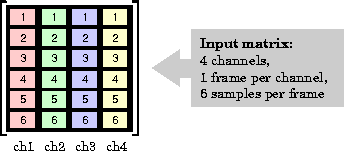
The Number of channels parameter specifies the number of independent channels (columns), N, in the matrix. Frame-based operation provides substantial increases in throughput rates, at the expense of greater model latency.
In frame-based operation, the block independently downsamples each channel in the input matrix by skipping K rows after each row that it passes through to the output. The downsample factor must be less than the frame size, K<M. The Framing parameter determines how the block adjusts the rate at the output. There are two available options:
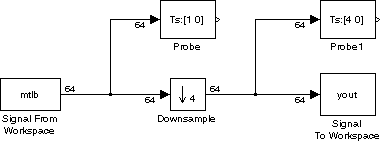
The block generates the output at the slower (downsampled) rate by using a proportionally longer frame period at the output port than at the input port. For downsampling by a factor of K, the output frame period is K times longer than the input frame period, but the input and output frame sizes are equal.
The example below shows a single-channel input with a frame period of 1 second (Sample time = 1/64 and Samples per frame = 64 in the Signal From Workspace block) being downsampled by a factor of 4 to a frame period of 4 seconds. The input and output frame sizes are identical.
The block generates the output at the slower (downsampled) rate by using a proportionally smaller frame size than the input. For downsampling by a factor of K, the output frame size is K times smaller than the input frame size, but the input and output frame rates are equal.
The example below shows a single-channel input of frame size 64 being downsampled by a factor of 4 to a frame size of 16. The input and output frame rates are identical.

In frame-based mode, the Initial condition can be an M-by-N matrix representing the initial input, or a scalar to be repeated across all elements of the M-by-N matrix. The first row of the matrix is added to the output buffer at t=0, the Dth row is added at t=K*Ts, the (D+K)th row at t=2K*Ts, and so on, where Ts is the sequence sample period.
Dialog Box
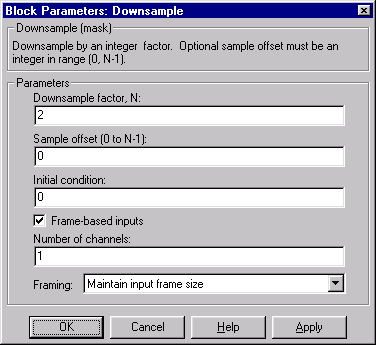
- Downsample factor
- The integer factor, K, by which to decrease the input sample rate.
- Sample offset
- The sample offset, D, which must be an integer in the range [0,K-1].
- Initial condition
- The value that the block is initialized with; a scalar or vector in sample-based mode, a scalar or matrix in frame-based mode.
- Frame-based inputs
- Selects frame-based operation.
- Number of channels
- For frame-based operation, the number of channels (columns) in the input matrix, N.
- Framing
- For frame-based operation, the method by which to implement the downsampling: decrease the output sample rate, or decrease the output frame size.
See Also
FIR Decimation
FIR Rate Conversion
Repeat
Upsample
[ Previous | Help Desk | Next ]