
| DSP Blockset | Search Help Desk |
| Dyadic Analysis Filter Bank | See Also |
Decompose a signal into components of equal or logarithmically decreasing frequency intervals and sample rates.
Library
Multirate Filters, in FilteringDescription
The Dyadic Analysis Filter Bank block decomposes a broadband signal into a collection of successively more bandlimited components by repeatedly dividing the frequency range. The typical (asymmetric) n-level filter bank structure is shown below: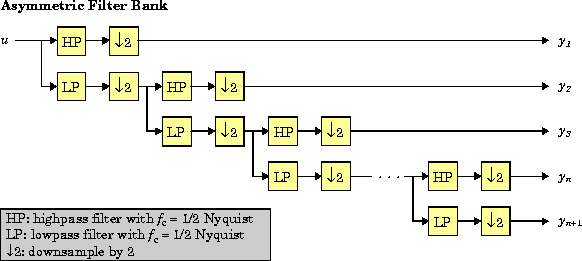 At each level, the low-frequency output of the previous level is decomposed into adjacent high- and low-frequency subbands by a highpass (HP) and lowpass (LP) filter pair. Each of the two output subbands is half the bandwidth of the input to that level (hence "dyadic"). The bandlimited output of each filter is maximally decimated by a factor of 2 to preserve the bit rate of the original signal. In wavelet applications (see below) the aliasing introduced by the decimation stage can be exactly canceled in reconstruction.
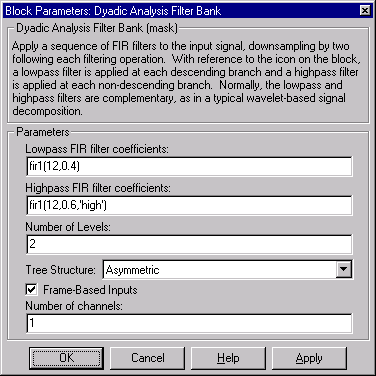
The Lowpass FIR filter coefficients and Highpass FIR filter coefficients parameters specify the filter coefficients to be used for every highpass and lowpass (respectively) filter in the structure. The values of these coefficients are typically computed using the wavelet family functions in the Wavelet Toolbox (see the Wavelet Toolbox User's Guide for more information).
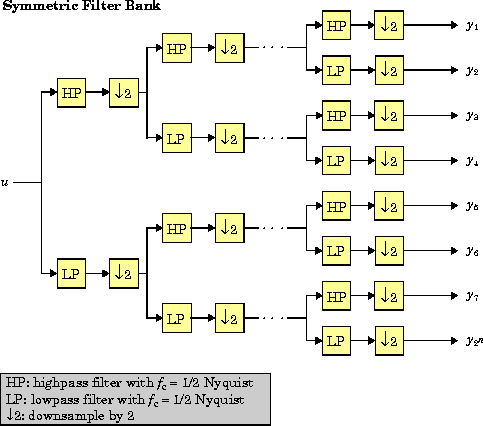
The Tree structure parameter specifies an asymmetric (or wavelet) tree, as shown above, or a symmetric structure, as shown below. Note that the symmetric structure decomposes both the high- and low-frequency subbands at each level, whereas the asymmetric structure only decomposes the low-frequency bands.
At each level, the low-frequency output of the previous level is decomposed into adjacent high- and low-frequency subbands by a highpass (HP) and lowpass (LP) filter pair. Each of the two output subbands is half the bandwidth of the input to that level (hence "dyadic"). The bandlimited output of each filter is maximally decimated by a factor of 2 to preserve the bit rate of the original signal. In wavelet applications (see below) the aliasing introduced by the decimation stage can be exactly canceled in reconstruction.
The Lowpass FIR filter coefficients and Highpass FIR filter coefficients parameters specify the filter coefficients to be used for every highpass and lowpass (respectively) filter in the structure. The values of these coefficients are typically computed using the wavelet family functions in the Wavelet Toolbox (see the Wavelet Toolbox User's Guide for more information).
The Tree structure parameter specifies an asymmetric (or wavelet) tree, as shown above, or a symmetric structure, as shown below. Note that the symmetric structure decomposes both the high- and low-frequency subbands at each level, whereas the asymmetric structure only decomposes the low-frequency bands.
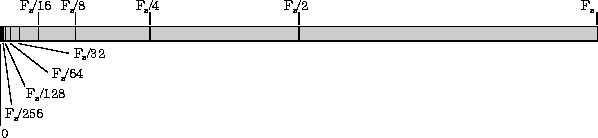
 The asymmetric structure in the first figure (Tree structure set to Asymmetric) has n+1 outputs, where n is the number of levels. The sample rate and bandwidth of the top output are half the input sample rate and bandwidth. The sample rate and bandwidth of each additional output (except the last) are half that of the output from the previous level.



 ,
,
 The symmetric structure (Tree structure set to Symmetric) has 2n outputs, where n is the number of levels. The sample rate and bandwidth of each output are equal.
The Frame-based inputs parameter allows you to choose between sample-based and frame-based operation.
The symmetric structure (Tree structure set to Symmetric) has 2n outputs, where n is the number of levels. The sample rate and bandwidth of each output are equal.
The Frame-based inputs parameter allows you to choose between sample-based and frame-based operation.
Sample-Based Operation
When the check box is not selected (default), the block assumes that the input is a 1-by-N sample vector or M-by-N sample matrix. Each of the N vector elements (or M*N matrix elements) is treated as an independent channel, and the block filters each channel independently over time. The output at each port is the same size as the input, with one channel for each input channel. As described earlier, for the asymmetric tree structure, each output port has a different sample period. Example: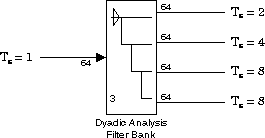
Frame-Based Operation
When the Frame-based inputs check box is selected, the block assumes that the input at each port is an M-by-N frame matrix. Each of the N frames in the matrix contains M sequential time samples from an independent signal, where M must be a multiple of 2n, and n is the number of filter bank levels. The illustration below shows a 8-by-4 matrix input, which would be appropriate for a 3-level tree (23=8):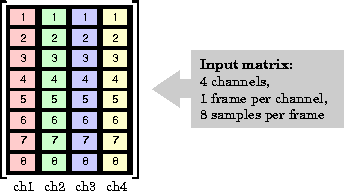 The Number of channels parameter specifies the number of independent channels (columns), N, in the matrix, and the block filters each channel independently over time. The number of columns in each output is therefore the same as the number of columns in the input.
For the asymmetric tree structure, each output port has the same period as the input. The reduction in the output sample rates results from the smaller output frame sizes, as shown in the example below.
The Number of channels parameter specifies the number of independent channels (columns), N, in the matrix, and the block filters each channel independently over time. The number of columns in each output is therefore the same as the number of columns in the input.
For the asymmetric tree structure, each output port has the same period as the input. The reduction in the output sample rates results from the smaller output frame sizes, as shown in the example below.
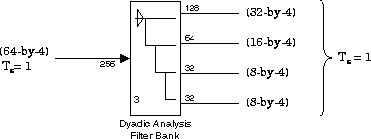 Frame-based operation provides substantial increases in throughput rates, at the expense of greater model latency.
Applications
The primary application for dyadic analysis filter banks is coding for data compression using wavelets. At the transmitting end, the output of the dyadic analysis filter bank is fed to a lossy compression scheme, which typically assigns the number of bits for each filter bank output in proportion to the relative energy in that frequency band. This represents more powerful components of the signal by a greater number of bits than less powerful signal components. At the receiving end, the transmission is decoded and fed to a dyadic synthesis filter bank to reconstruct the original signal. The filter coefficients of the complementary analysis and synthesis stages are designed to cancel aliasing introduced by the filtering and resampling.
Note
At the receiving end, the transmission is decoded and fed to a dyadic synthesis filter bank to reconstruct the original signal. The filter coefficients of the complementary analysis and synthesis stages are designed to cancel aliasing introduced by the filtering and resampling.
Note
Dialog Box
References
Fliege, N. J. Multirate Digital Signal Processing: Multirate Systems, Filter Banks, Wavelets. West Sussex, England: John Wiley & Sons, 1994. Strang, G. and T. Nguyen. Wavelets and Filter Banks. Wellesley, MA: Wellesley-Cambridge Press, 1996. Vaidyanathan, P. P. Multirate Systems and Filter Banks. Englewood Cliffs, NJ: Prentice Hall, 1993.See Also
Dyadic Synthesis Filter Bank