| Power System Blockset | Search Help Desk |
| Mutual Inductance | Examples See Also |
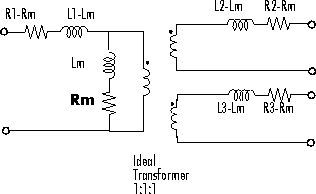
Implement a magnetic coupling between two or three windings
Library
Elements LibraryDescription
If the entry for the third winding is set to zero, the block represents the magnetic coupling between two inductances and a new icon is displayed
Inputs and Outputs
The inputs of the Mutual Impedance block are at the same instantaneous polarity.Dialog Box
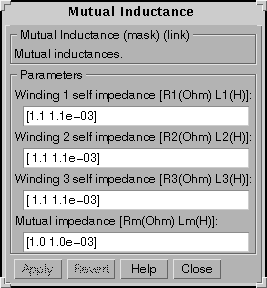
Limitations
Due to modeling constraints, the following restrictions apply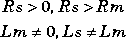 :
The winding resistances (self resistances) must be positive and greater than the mutual resistance. Negative values are allowed for the self and mutual inductances as long as the self inductances are different from the mutual inductance. The mutual inductance must be different from zero but a zero mutual resistance is allowed.
Windings can be left floating (i.e, not connected by an impedance to the rest of the circuit). The floating winding will be internally connected to the main circuit through a resistor. This invisible connection does not affect voltage and current measurements.
:
The winding resistances (self resistances) must be positive and greater than the mutual resistance. Negative values are allowed for the self and mutual inductances as long as the self inductances are different from the mutual inductance. The mutual inductance must be different from zero but a zero mutual resistance is allowed.
Windings can be left floating (i.e, not connected by an impedance to the rest of the circuit). The floating winding will be internally connected to the main circuit through a resistor. This invisible connection does not affect voltage and current measurements.
Example
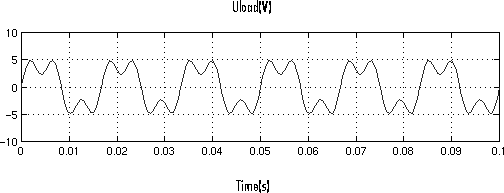
Three coupled windings are used to inject a third harmonic voltage into a circuit fed at 60 Hz.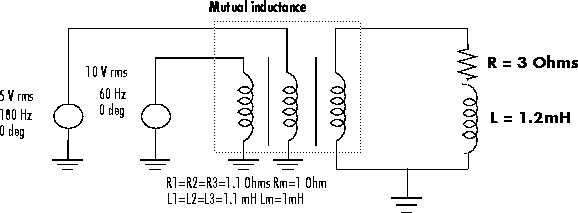
This example is available in the psbmutual.mdl file.
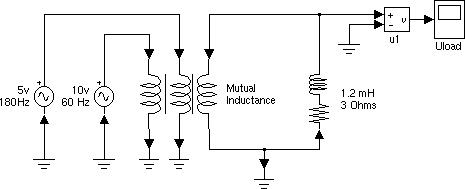
Simulation produces the following load voltage waveform:
See Also
Linear Transformer, Saturable Transformer