| Power System Blockset | Search Help Desk |
| Saturable Transformer | See Also |
Implement a two- or three-winding saturable transformer
Library
Elements LibraryDescription
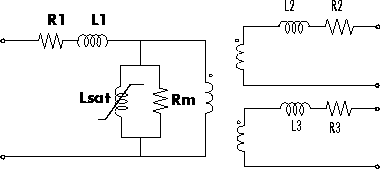
The model takes into account the winding resistances (R1 R2 R3), the leakage inductances (L1 L2 L3) as well as the magnetizing characteristics of the core, which is modeled by a resistance Rm simulating the core active losses and a saturable inductance Lsat. The saturation characteristic is specified as a piece-wise linear characteristic.
Dialog Box and Parameters
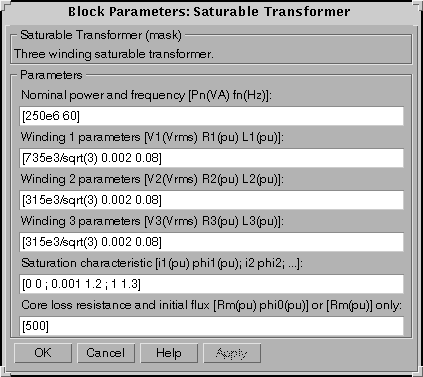
Specify in the first entry the nominal power rating and frequency of the transformer.
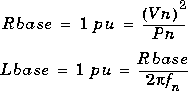
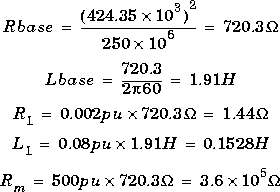
Then specify in the following three entries the parameters of each winding (nominal voltage in volt rms, resistance, and leakage inductance in p.u). The fifth entry is used to specify the saturation characteristic. Specify a series of current (pu)/flux (pu) pairs starting with (0,0). Specify in the last entry the active power dissipated in the core by entering the equivalent resistance Rm in pu. In the last entry you can also specify the initial flux phi0(p.u). This initial flux becomes particularly important when the transformer is energized. If phi0 is not specified, the initial flux will be automatically adjusted so that the simulation starts in steady-state. To comply with industry practice, you must enter the resistance and inductances in per unit (pu) based on the transformer rated power (Pn in VA) and nominal voltage of the winding (Vn in Vrms). The base resistance and inductance are defined as follows:For example, for the default parameters specified in the dialog box.
Inputs and Outputs
Input one, output one and output three (if it exists) are at the same instantaneous polarity. If you set the entry for the third winding to zero, the blockset will consider a transformer with two windings and a new icon will be displayed:Restrictions
Because of modeling constraints the following restrictions apply: The winding resistances cannot be set to zero; however, leakage inductances can be set to zero. Use values as small as possible to simulate quasi-zero resistances. Similarly, the magnetizing resistance Rm must have a finite value. Windings can be left floating (i.e, not connected by an impedance to the rest of the circuit). However, the floating winding will be connected internally to the main circuit through a resistor. This invisible connection does not affect voltage and current measurements. Figure (a) shows the piece-wise linear saturation characteristic. The points 2, 3, and 4 are entered as (i, phi) pair values in the dialog box Saturation characteristic section. The saturation model does not include hysteresis. Therefore, if you want to specify a residual flux phi0, the second point of the saturation characteristic should correspond to a zero current as shown on the figure (b) below.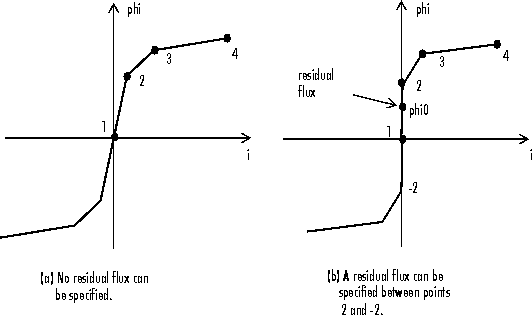
Example
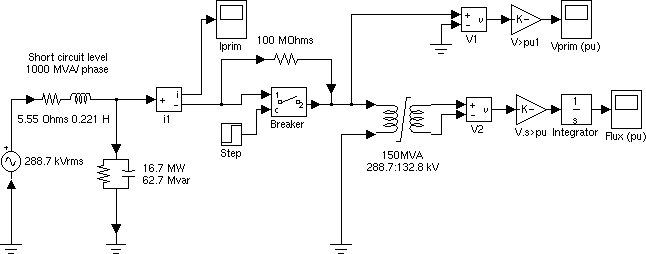
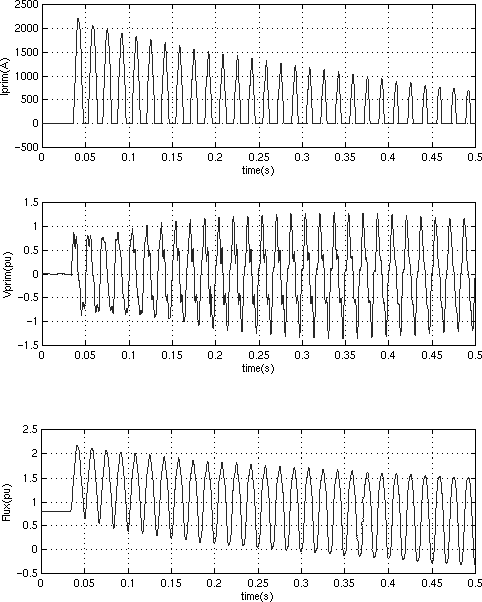
This circuit is available in psbxfosaturable.mdl. It illustrates the transformer saturation effect on system current and voltage. Plotted waveforms show the transformer inrush current, the primary voltage and the flux.
See Also
Linear Transformer, Mutual Inductance