| Using Simulink | Search Help Desk |
Algebraic Loops
Some Simulink blocks have input ports with direct feedthrough. This means that the output of these blocks cannot be computed without knowing the values of the signals entering the blocks at these input ports. Some examples of blocks with direct feedthrough inputs are: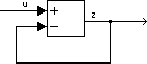
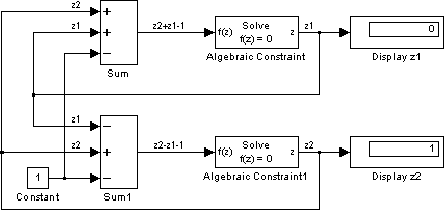
Algebraic Constraint) is a convenient way to model algebraic equations and specify initial guesses. The Algebraic Constraint block constrains its input signal F(z) to zero and outputs an algebraic state z. This block outputs the value necessary to produce a zero at the input. The output must affect the input through some feedback path. You can provide an initial guess of the algebraic state value in the block's dialog box to improve algebraic loop solver efficiency.
A scalar algebraic loop represents a scalar algebraic equation or constraint of the form F(z) = 0, where z is the output of one of the blocks in the loop and the function F consists of the feedback path through the other blocks in the loop to the input of the block. In the simple one-block example shown on the previous page, F(z) = z - (u - z). In the vector loop example shown above, the equations are:
z2 + z1 - 1 = 0
z2 - z1 - 1 = 0
Algebraic loops arise when a model includes an algebraic constraint F(z) = 0. This constraint may arise as a consequence of the physical interconnectivity of the system you are modeling, or it may arise because you are specifically trying to model a differential/algebraic system (DAE). When a model contains an algebraic loop, Simulink calls a loop solving routine at each time step. The loop solver performs iterations to determine the solution to the problem (if it can). As a result, models with algebraic loops run slower than models without them. To solve F(z) = 0, the Simulink loop solver uses Newton's method with weak line search and rank-one updates to a Jacobian matrix of partial derivatives. Although the method is robust, it is possible to create loops for which the loop solver will not converge without a good initial guess for the algebraic states z. You can specify an initial guess for a line in an algebraic loop by placing an IC block (which is normally used to specify an initial condition for a signal) on that line. As shown above, another way to specify an initial guess for a line in an algebraic loop is to use an Algebraic Constraint block. Whenever possible, use an IC block or an Algebraic Constraint block to specify an initial guess for the algebraic state variables in a loop.
Non-Algebraic Direct-Feedthrough Loops
There are exceptions to the general rule that all loops comprising direct-feedthrough blocks are algebraic. The exceptions are: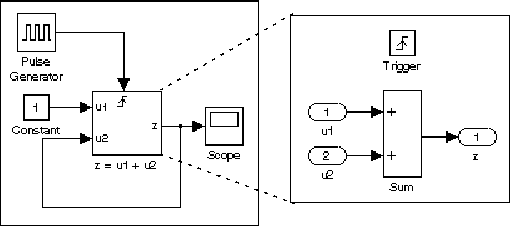
z = 1 + uwhere
u is the value of z the last time the subsystem was triggered. The output of the system is a staircase function as illustrated by the display on the system's scope.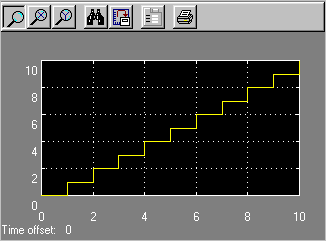
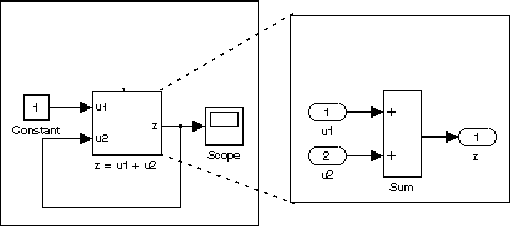
u2 port of the adder subsystem is equal to the subsystem's output at the current time step for every time step. The mathematical representation of this system
z = z + 1reveals that it has no mathematically valid solution.