
| Signal Processing Toolbox | Search Help Desk |
| remez | Examples See Also |
Parks-McClellan optimal FIR filter design.
Syntax
b = remez(n,f,a)
b = remez(n,f,a,w)
b = remez(n,f,a,'ftype')
b = remez(n,f,a,w,'ftype')
b = remez(...,{lgrid})
b = remez(n,f,'fresp',w)
b = remez(n,f,'fresp',w,'ftype')
b = remez(n,f,{'fresp',p1,p2,...},w)
b = remez(n,f,{'fresp',p1,p2,...},w,'ftype')
[b,delta] = remez(...)
[b,delta,opt] = remez(...)
Description
remez designs a linear-phase FIR filter using the Parks-McClellan algorithm [1]. The Parks-McClellan algorithm uses the Remez exchange algorithm and Chebyshev approximation theory to design filters with an optimal fit between the desired and actual frequency responses. The filters are optimal in the sense that the maximum error between the desired frequency response and the actual frequency response is minimized. Filters designed this way exhibit an equiripple behavior in their frequency responses and hence are sometimes called equiripple filters.
b = remez(n,f,a)
returns row vector b containing the n+1 coefficients of the order n FIR filter whose frequency-amplitude characteristics match those given by vectors f and a.
The output filter coefficients (taps) in b obey the symmetry relation
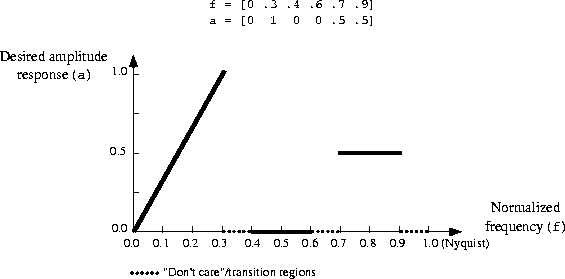
f and a specify the frequency-magnitude characteristics of the filter:
f is a vector of pairs of frequency points, specified in the range between 0 and 1, where 1 corresponds to half the sampling frequency (the Nyquist frequency). The frequencies must be in increasing order.
a is a vector containing the desired amplitudes at the points specified in f.
The desired amplitude at frequencies between pairs of points (f(k), f(k+1)) for k odd is the line segment connecting the points (f(k), a(k)) and (f(k+1), a(k+1)).
The desired amplitude at frequencies between pairs of points (f(k), f(k+1)) for k even is unspecified. The areas between such points are transition or "don't care" regions.
f and a must be the same length. The length must be an even number.
f and a vectors in defining a desired frequency response is shown below:
remez(n,f,a,w)
uses the weights in vector w to weight the fit in each frequency band. The length of w is half the length of f and a, so there is exactly one weight per band.
b = remez(n,f,a,'ftype')
and
b = remez(n,f,a,w,'ftype')
specify a filter type, where ftype is
hilbert, for linear-phase filters with odd symmetry (type III and type IV)
The output coefficients in b obey the relation b(k) = -b(n + 2 -k), k = 1,...,n + 1. This class of filters includes the Hilbert transformer, which has a desired amplitude of 1 across the entire band.
For example,
h = remez(30,[0.1 0.9],[1 1],'hilbert');
designs an approximate FIR Hilbert transformer of length 31.
differentiator, for type III and IV filters, using a special weighting technique
For nonzero amplitude bands, it weights the error by a factor of 1/f so that the error at low frequencies is much smaller than at high frequencies. For FIR differentiators, which have an amplitude characteristic proportional to frequency, these filters minimize the maximum relative error (the maximum of the ratio of the error to the desired amplitude).
b = remez(...,{lgrid})
lgrid to control the density of the frequency grid, which has roughly (lgrid*n)/(2*bw) frequency points, where bw is the fraction of the total frequency band interval [0,1] covered by f. Increasing lgrid often results in filters that are more exactly equiripple, but which take longer to compute. The default value of 16 is the minimum value that should be specified for lgrid. Note that the {lgrid} argument must be a 1-by-1 cell array.
b = remez(n,f,'fresp',w)
returns row vector b containing the n+1 coefficients of the order n FIR filter whose frequency-amplitude characteristics best approximate the response specified by function fresp. The function is called from within remez with the following syntax:
The arguments are similar to those for[dh,dw] =fresp(n,f,gf,w)
remez:
n is the filter order.
f is the vector of frequency band edges that appear monotonically between 0 and 1, where 1 is the Nyquist frequency.
gf is a vector of grid points that have been linearly interpolated over each specified frequency band by remez. gf determines the frequency grid at which the response function must be evaluated, and contains the same data returned by cremez in the fgrid field of the opt structure.
w is a vector of real, positive weights, one per band, used during optimization. w is optional in the call to remez; if not specified, it is set to unity weighting before being passed to 'fresp'.
dh and dw are the desired complex frequency response and band weight vectors, respectively, evaluated at each frequency in grid gf.
fresp) that remez calls is remezfrf in the signal/private directory.
b = remez(n,f,{'fresp',p1,p2,...},w)
allows you to specify additional parameters (p1, p2, etc.) to pass to fresp. Note that b = remez(n,f,a,w) is a synonym for b = remez(n,f,{'remezfrf',a},w), where a is a vector containing the desired amplitudes at the points specified in f.
b = remez(n,f,'fresp',w,'ftype')
and
b = remez(n,f,{'fresp',p1,p2,...},w,'ftype')
design antisymmetric (odd) rather than symmetric (even) filters, where 'ftype' is either 'd' for a differentiator or 'h' for a Hilbert transformer.
In the absence of a specification for ftype, a preliminary call is made to fresp to determine the default symmetry property sym. This call is made using the syntax:
The argumentssym =fresp('defaults',{n,f,[],w,p1,p2,...})
n, f, w, etc., may be used as necessary in determining an appropriate value for sym, which remez expects to be either 'even' or 'odd'. If the fresp function does not support this calling syntax, remez defaults to even symmetry.
[b,delta] = remez(...)
returns the maximum ripple height in delta.
[b,delta,opt] = remez(...)
opt, of optional results with the following fields. Example
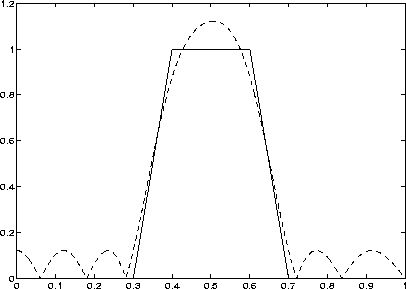
Graph the desired and actual frequency responses of a 17th-order Parks-McClellan bandpass filter:f = [0 0.3 0.4 0.6 0.7 1]; a = [0 0 1 1 0 0]; b = remez(17,f,a); [h,w] = freqz(b,1,512); plot(f,a,w/pi,abs(h))
Algorithm
remez is a MEX-file version of the original Fortran code from [1], altered to design arbitrarily long filters with arbitrarily many linear bands.
remez designs type I, II, III, and IV linear-phase filters. Type I and Type II are the defaults for n even and n odd, respectively, while Type III (n even) and Type IV (n odd) are obtained with the 'hilbert' and 'differentiator' flags. The different types of filters have different symmetries and certain constraints on their frequency responses (see [5] for more details).Diagnostics
An appropriate diagnostic message is displayed if incorrect arguments are used:Filter order must be 3 or more.
There should be one weight per band.
Frequency and amplitude vectors must be the same length.
The number of frequency points must be even.
Frequencies must lie between 0 and 1.
Frequencies must be specified in bands.
Frequencies must be nondecreasing.
Adjacent bands not allowed.
A more serious warning message is
-- Failure to Converge --
Probable cause is machine rounding error.
In the rare event that you see this message, it is possible that the filter design may still be correct. Verify the design by checking its frequency response.
See Also
butter |
Butterworth analog and digital filter design. |
cheby1 |
Chebyshev type I filter design (passband ripple). |
cheby2 |
Chebyshev type II filter design (stopband ripple). |
cremez |
Complex and nonlinear-phase equiripple FIR filter design. |
ellip |
Elliptic (Cauer) filter design. |
fir1 |
Window-based finite impulse response filter design - standard response. |
fir2 |
Window-based finite impulse response filter design - arbitrary response. |
fircls |
Constrained least square FIR filter design for multiband filters. |
fircls1 |
Constrained least square filter design for lowpass and highpass linear phase FIR filters. |
firls |
Least square linear-phase FIR filter design. |
firrcos |
Raised cosine FIR filter design. |
remezord |
Parks-McClellan optimal FIR filter order estimation. |
yulewalk |
Recursive digital filter design. |
References
[1] IEEE. Programs for Digital Signal Processing. IEEE Press. New York: John Wiley & Sons, 1979. Algorithm 5.1. [2] IEEE. Selected Papers in Digital Signal Processing, II. IEEE Press. New York: John Wiley & Sons, 1979. [3] Parks, T.W., and C.S. Burrus. Digital Filter Design. New York: John Wiley & Sons, 1987. Pg. 83. [4] Rabiner, L.R., J.H. McClellan, and T.W. Parks. "FIR Digital Filter Design Techniques Using Weighted Chebyshev Approximations." Proc. IEEE 63 (1975). [5] Oppenheim, A.V., and R.W. Schafer. Discrete-Time Signal Processing. Englewood Cliffs, NJ: Prentice Hall, 1989. Pgs. 256-266.
