Constrained least square filter design for lowpass and highpass linear phase FIR filters.
Syntax
b = fircls1(n,wo,dp,ds)
b = fircls1(n,wo,dp,ds,'high')
b = fircls1(n,wo,dp,ds,wt)
b = fircls1(n,wo,dp,ds,wt,'high')
b = fircls1(n,wo,dp,ds,wp,ws,k)
b = fircls1(n,wo,dp,ds,wp,ws,k,'high')
b = fircls1(n,wo,dp,ds,,'design_flag')
Description
b = fircls1(n,wo,dp,ds)
generates a lowpass FIR filter b. n+1 is the filter length, wo is the normalized cutoff frequency in the range between 0 and 1 (where 1 corresponds to half the sampling frequency, that is, the Nyquist frequency), dp is the maximum passband deviation from 1 (passband ripple), and ds is the maximum stopband deviation from 0 (stopband ripple).
b = fircls1(n,wo,dp,ds,'high')
generates a highpass FIR filter b.
b = fircls1(n,wo,dp,ds,wt)
and
b = fircls1(n,wo,dp,ds,wt,'high')
specify a frequency wt above which (for wt>wo) or below which (for wt<wo) the filter is guaranteed to meet the given band criterion. This will help you design a filter that meets a passband or stopband edge requirement. There are four cases:
b = fircls1(n,wo,dp,ds,wp,ws,k)
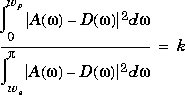
generates a lowpass FIR filter b with a weighted function. n+1 is the filter length, wo is the normalized cutoff frequency, dp is the maximum passband deviation from 1 (passband ripple), and ds is the maximum stopband deviation from 0 (stopband ripple). wp is the passband edge of the L2 weight function and ws is the stopband edge of the L2 weight function, where wp < wo < ws. k is the ratio (passband L2 error)/(stopband L2 error):
b = fircls1(n,wo,dp,ds,wp,ws,k,'high')
generates a highpass FIR filter b with a weighted function, where ws < wo < wp.
b = fircls1(n,wo,dp,ds,,'design_flag')
enables you to monitor the filter design, where design_flag can be
NOTE
In the design of very narrow band filters with small dp and ds, there may not exist a filter of the given length that meets the specifications.
Example
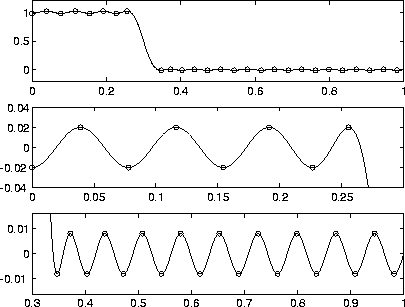
Design an order 55 lowpass filter with a cutoff frequency at 0.3:
n = 55; wo = 0.3;
dp = 0.02; ds = 0.008;
b = fircls1(n,wo,dp,ds,'plots'); % plot magnitude response
Algorithm
The algorithm is a multiple exchange algorithm that uses Lagrange multipliers and Kuhn-Tucker conditions on each iteration.
See Also
fircls
|
Constrained least square FIR filter design for multiband filters.
|
firls
|
Least square linear-phase FIR filter design.
|
remez
|
Parks-McClellan optimal FIR filter design.
|
References
[1] Selesnick, I.W., M. Lang, and C.S. Burrus. "Constrained Least Square Design of FIR Filters without Specified Transition Bands." Proceedings of the IEEE Int. Conf. Acoust., Speech, Signal Processing. Vol. 2 (May 1995). Pgs. 1260-1263.
[2] Selesnick, I.W., M. Lang, and C.S. Burrus. "Constrained Least Square Design of FIR Filters without Specified Transition Bands." IEEE Transactions on Signal Processing, Vol. 44, No. 8 (August 1996).
[ Previous | Help Desk | Next ]