| Power System Blockset | Search Help Desk |
| Surge Arrester | Examples |
Implement a Metal-Oxide surge arrester
Library
Elements LibraryDescription
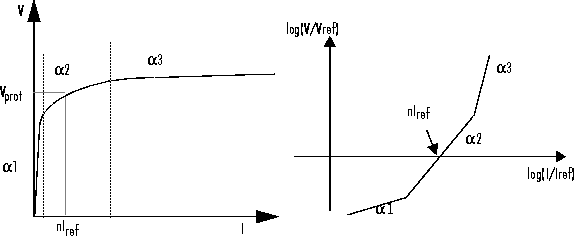
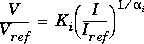
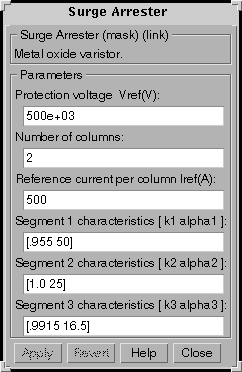
The protection voltage obtained with a single column is specified at a reference current (usually 500A or 1kA). Default parameters k and  given in the dialog box fit the average V-I characteristic provided by the main metal oxide arrester manufacturers. They do not change with the protection voltage. The required protection voltage is obtained by adding discs of zinc oxide in series in each column.
Dialog Box
Restrictions
The Surge Arrester block is modeled as a current source driven by the voltage appearing across its terminals. Therefore, it cannot be connected in series with an inductor or another current source. As the Surge Arrester is highly nonlinear a stiff integrator algorithm must be used to simulate the circuit.ode15s and ode23tb solvers with default parameters usually give the best simulation speed. As this element contains no states, it will produce an algebraic loop because its current (input to state space model of the circuit) varies simultaneously with the voltage (output of state-space model). Simulink will signal an algebraic loop, but it usually solves the circuit without difficulty.
Example
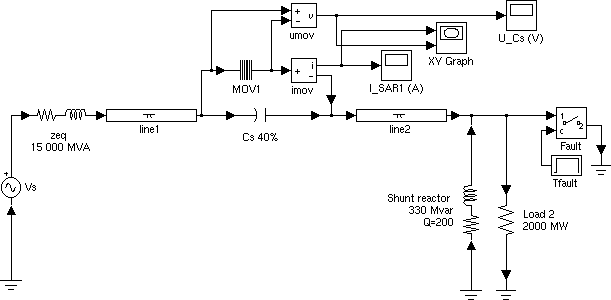
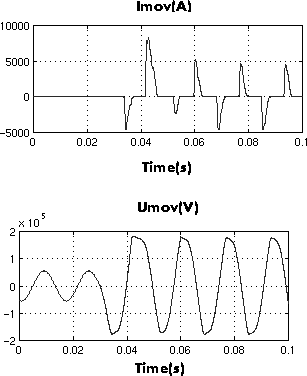
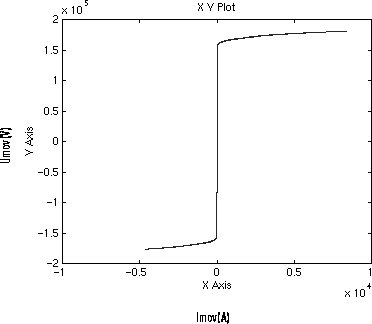
The example provided in thepsbarrester.mdl demonstration file illustrates the use of metal oxide varistors (MOV) on a 735 kV series compensated network. Only one phase of the network is represented. The capacitor connected in series with the line is protected by a 30 column arrester. At t=0.03 seconds, a fault is applied at the load terminals. The current increases in the series capacitor and produces an overvoltage which is limited by the MOV. Then the fault is cleared at t=0.3 seconds. At fault application, the resulting overvoltage makes the MOV to conduct. The waveforms displayed by Umov and Imov measurements as well as the V-I characteristic plotted by the X-Y scope are shown below.