| Power System Blockset | Search Help Desk |
| Simplified Synchronous Machine | Examples See Also |
Model the dynamics of a simplified three-phase synchronous machine
Library
Machines LibraryDescription

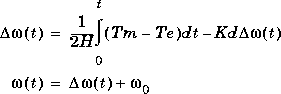
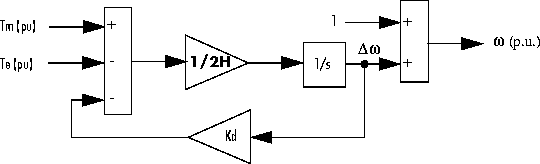
 = Speed variation with respect to speed of operation
H = Constant of inertia
Tm = Mechanical torque
Te = Electromagnetic torque
Kd = Damping factor
(t) = Mechanical speed of rotor
0 = Speed of operation (1pu)
Parameters and Dialog Box
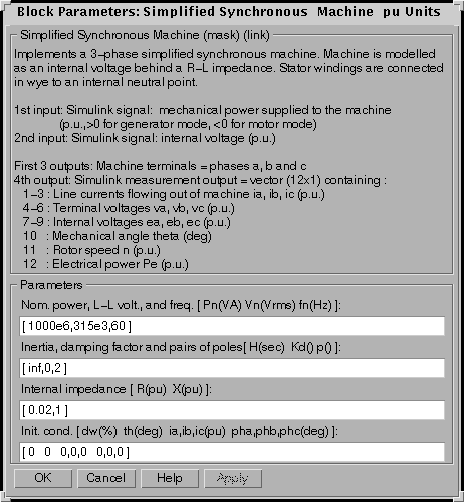
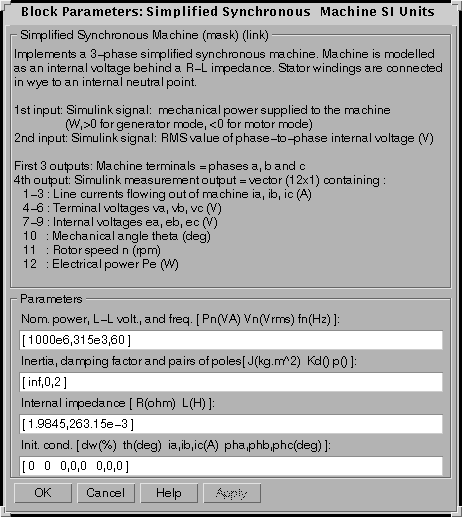
In the powerlib library you can choose between two Simplified Synchronous Machine blocks to specify the electrical and mechanical parameters of the model. Per Unit (pu) Dialog BoxThe nominal power, frequency and voltage are used to compute nominal torque and convert SI units to pu.
The moment of inertia and damping factor are used to model the mechanical behavior of the machine. The damping factor has been scaled to act like the damping factor of a second order system. This means that for no overshoot and minimum settling time, a damping factor of 0.9 would be used. The internal impedance specifies the value of resistance and reactance for each phase. The initial speed deviation and angle specify the initial conditions of the two integrators in the mechanical part of the model. Finally, initial values for the three line currents can also be specified, which allows the simulation to be started in steady-state. Note: These two blocks simulate exactly the same Simplified Synchronous machine model; the only difference is the way of entering the parameter units.Inputs and Outputs
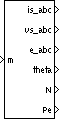
The first input of the Simplified Synchronous Machine block is the mechanical power supplied to the machine. This input can be a constant or the output of the Hydraulic Turbine and Governor block. The frequency of the voltage sources depends on the mechanical speed of the machine. The amplitude of these voltages is given by the second input of the block, which can be a constant or the output of a voltage regulator. If you use SI units, these two inputs should be in watts and volts phase-to-phase rms. If you use pu both inputs should be in pu The first three outputs are the electrical terminals of the stator. The last output of the block is a vector containing the following 12 variables:
Assumptions
The electrical system of the Simplified Synchronous Machine consists solely of a voltage source behind a synchronous reactance and resistance. All the other self and mutual inductances of the armature, field and damping windings are neglected. The three voltage sources and RL impedance branches are Y-connected (3 wires). The load may or may not be balanced.Example
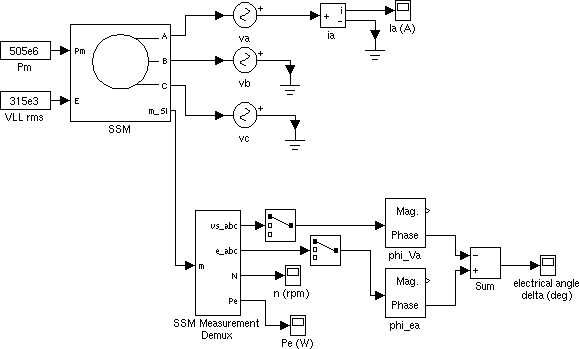
The following example uses the Simplified Synchronous Machine block. In this example, the Simplified Synchronous Machine representing a 1000 MVA 315 kV equivalent source is connected to an infinite bus (three AC Voltage Source blocks) and is used as a synchronous generator. The R term is necessary to prevent series connection of the two current sources modeling the machine and the external inductance. The internal resistance of the machine is set to 0.02 pu, or 1.9845 ohms. Its inductance is set in such a way that the total impedance is 1 pu (L=263.15 mH). The inertia of the machine is 56290 kg.m2. This example is included in thepsbsimplealt.mdl file.In this example, the machine has an initial speed deviation of 0.5%. The initial mechanical angle and the initial currents ia, ib, ic are set to zero. The power transfer between the machine and the bus is given by the following relation:
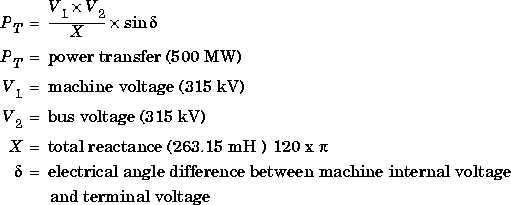 With the above parameters, the steady-state internal voltage is 30 degrees ahead of the terminal voltage (
 =+30 deg).
The machine is supplied with 505 MW of mechanical power in order to compensate for the machine resistive losses. The electrical angle is displayed as the phase difference between the internal and terminal voltage of phase A. With Simulation Parameters set as follows, the following results are obtained.
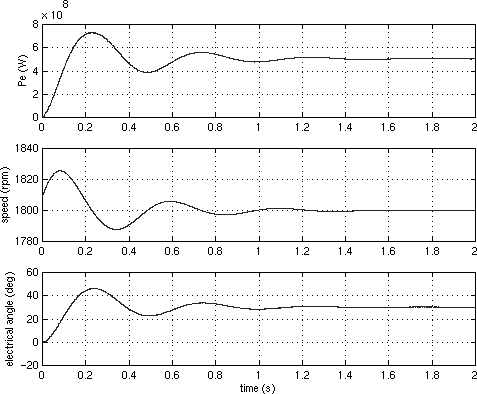
The speed vs. time graph clearly shows that the machine is initially running at a speed of 1.005 pu (1809 rpm) and that speed stabilizes itself at its nominal value of 1800 rpm. As expected the electrical power supplied by the machine stabilizes at 500 MW and the electrical angle starts from zero and stabilizes at 30 degrees. The mechanical system is clearly under-damped, the damping factor being set to 0.3.
=+30 deg).
The machine is supplied with 505 MW of mechanical power in order to compensate for the machine resistive losses. The electrical angle is displayed as the phase difference between the internal and terminal voltage of phase A. With Simulation Parameters set as follows, the following results are obtained.
The speed vs. time graph clearly shows that the machine is initially running at a speed of 1.005 pu (1809 rpm) and that speed stabilizes itself at its nominal value of 1800 rpm. As expected the electrical power supplied by the machine stabilizes at 500 MW and the electrical angle starts from zero and stabilizes at 30 degrees. The mechanical system is clearly under-damped, the damping factor being set to 0.3.
See Also
Synchronous Machine, Hydraulic Turbine and Governor