| Power System Blockset | Search Help Desk |
| Permanent Magnet Synchronous Machine | Examples |
Model the dynamics of a three-phase permanent magnet synchronous machine with sinusoidal flux distribution
Library
Machines LibraryDescription
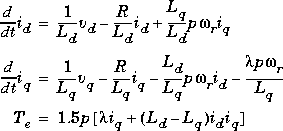
 :
: angular velocity of the rotor
 : amplitude of the flux induced by the permanent magnets of the rotor in the stator phases
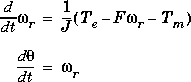
 : Rotor angular position
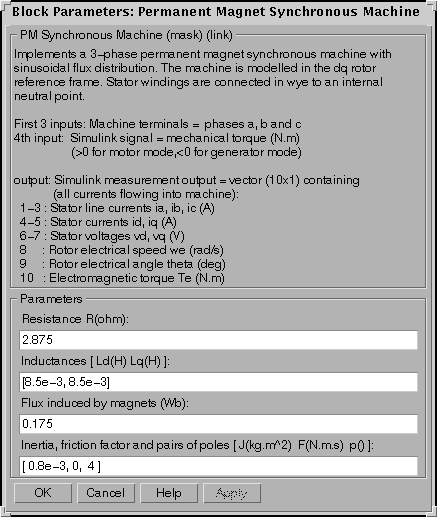
Dialog Box
Inputs and Outputs
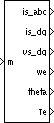
The first three inputs are the electrical connections of the machine's stator. The fourth input is the mechanical torque at the machine's shaft (Simulink signal). This input should ordinarily be positive because the PMSM block is usually used in a motor mode. Nevertheless, you can apply a negative torque input if you choose to use the PMSM block in generating mode. The block outputs a vector containing the following ten variables (all currents flowing into machine): , in rad/sec;
 , in degrees;
Assumption
The block assumes a linear magnetic circuit with no saturation of the stator and rotor iron. This assumption can be made because of the large air gap usually found in permanent magnet synchronous machines.Example
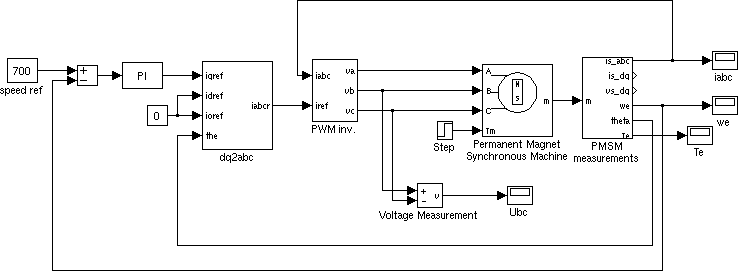
This example illustrates the use of the PMSM block in the motoring mode with a closed-loop control system built entirely in Simulink. The interfacing is done using Controlled Voltage Source blocks from the powerlib/Electrical Sources library. The complete system consists of a PWM inverter built with ideal switches (Simulink Relay blocks). Two control loops are used; the inner loop is used to regulate the motor line currents and the outer loop regulates the motor's speed. The mechanical torque applied at the motor's shaft is originally 3 N.m (nominal) and steps to 1 N.m at t=0.025 sec. The parameters of the machine are those found in the Dialog Box section.
Open the Simulink diagram by typing psbpmmotor or by choosing Permanent Magnet Sync Mach (sim) from the demos group in the powerlib library. Set the simulation parameters as follows:
Integrator type: Stiff, ode15s
Stop time: 0.06
Integration options: Use default options, except for Absolute tolerance which you can set to 1e-3.
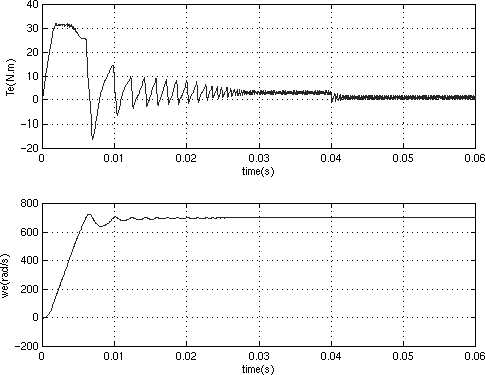
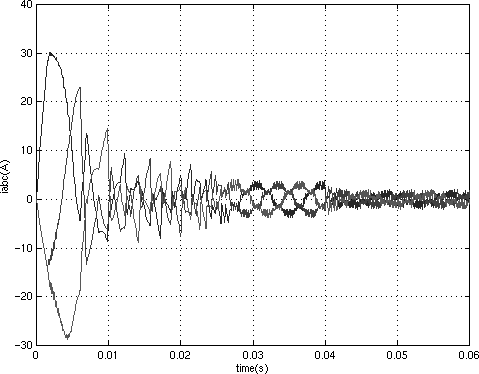
The torque climbs to nearly 32 N.m when the motor starts but stabilizes rapidly to its nominal value (3 N.m), until the step is applied, at which point the torque oscillates slightly before stabilizing to its new value (1 N.m). As for the speed, you can see that it stabilizes quite fast at start-up and is not affected by the load step. Now, observe the line currents.