| DSP Blockset | Search Help Desk |
Unbuffering Frame-Based Signals
The Buffers library contains two blocks that unbuffer frame-based sequences into sample-based sequences: Unbuffer and Partial Unbuffer.The Unbuffer Block
The Unbuffer block lets you specify the block's initial output (Initial condition) and the number of channels in the input (number of columns in matrix).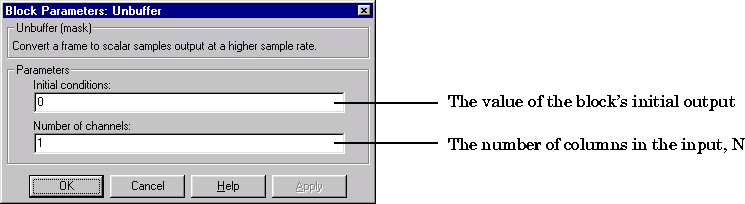
The frame-based input to the block can be a single-channel signal (frame vector sequence) or a multichannel signal (frame matrix sequence). In both cases, the Unbuffer block converts the entire input frame to a sample-based output.
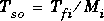
The sample period of the sample-based output, Tso, is related to the input frame period, Tfi, by the input frame size, Mi.
4. Each sample (row) of the input matrix is output separately. The input frame period and frame size are both 3, so the output sample period is 1.
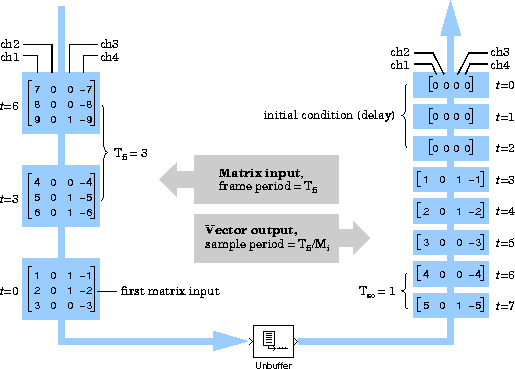
The Unbuffer block delays inputs by one frame length (Tfi seconds); see "Initial State of Buffer Blocks" later in this section for more about the unbuffering delay.
The Partial Unbuffer Block
The Partial Unbuffer block unbuffers a selected portion of the input frame into a sample-based output. The First output index (M1) and the Last output index (M2) parameters determine the range of samples to be unbuffered from the input frame. For a multichannel inputu, only rows u(M1:M2,:) are unbuffered to the output; all other input samples are discarded.
The output sample period is related to the input sample period by
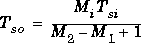
 M1), the block generates an error.