| DSP Blockset | Search Help Desk |
Rebuffering Frame-Based Signals
The Rebuffer block is the primary block for converting a frame-based signal to a new frame size. The block lets you specify the Buffer size, the number of Buffer overlap points, and the block's initial output (Initial condition).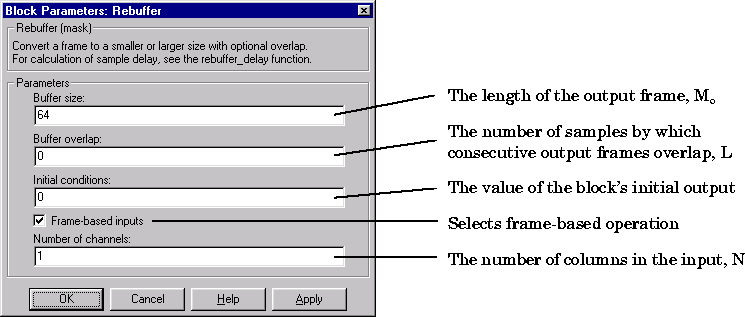
The block's Frame-based inputs parameter allows you to toggle the block from sample-based mode to frame-based mode. In sample-based mode (Frame-based inputs unchecked), the Rebuffer block operates the same as the buffer block described above.
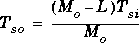
In frame-based mode (Frame-based inputs checked), the input to the block can be a single channel signal (frame vector sequence) or a multichannel signal (frame matrix sequence). In both cases, the block acquires the number of new samples (input rows) specified by the difference between the Buffer size (Mo) and Buffer overlap (L) parameters. Because the block can rebuffer a signal to a larger or smaller frame size, the number of samples acquired from the input can be greater or less than the number of samples in an individual input frame. The output frame period, Tfo, is related to the input sample period, Tsi, by
Example: Single-Channel Rebuffering
The figure below illustrates overlapping buffering of a one-channel signal. The Buffer size is 3 and the Buffer overlap is 1. The input sample period (Tsi) is 1, so the output frame period (Tfo) is 2, and the output sample period (Tso) is 2/3.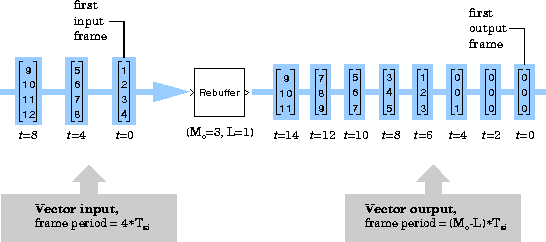
Computing Rebuffering Delay.
Note that the sequence is delayed by eight samples, and the first eight output samples adopt the value specified for the Initial condition, which is zero in this example. You can use the rebuffer_delay function to determine the length of this initial delay for any combination of frame size and overlap.
d = rebuffer_delay(4,3,1)
d =
     8
This agrees with the block's output above.
Example: Multichannel Rebuffering
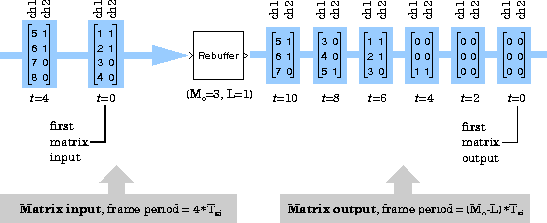
The next figure illustrates overlapping buffering of a two-channel signal. Again, the Buffer size is 3 and the Buffer overlap is 1. As in the single-channel case, the input sample period of 1 generates an output frame period of 2 and an output sample period of 2/3.