| DSP Blockset | Search Help Desk |
Initial State of Buffer Blocks
The Buffer and Rebuffer Blocks
The Buffer and Rebuffer blocks are initialized to the value specified by the Initial condition parameter, which they output at the first simulation step. At the same sample time that the initial buffer is output, the Buffer and Rebuffer blocks read the first input sample into the next buffer. Once a Buffer or Rebuffer block has acquired Mo-L samples (where Mo is the Buffer size and L is the Buffer overlap), it outputs those samples in the second buffer at time Tsi*(Mo-L). Note1, 2, 3, ..., with sample period Ts. Given a Buffer size of 4, a Buffer overlap of 2, and the default Initial condition of 0:| 0 |
0 0 0 0 |
The first output - all zeros |
| 2*Ts |
0 0 1 2 |
|
| 4*Ts |
1 2 3 4 |
The first full buffer |
| 6*Ts |
3 4 5 6 |
|
| 8*Ts |
5 6 7 8 |
5 and a Buffer overlap of 3:| 0 | 0 0 0 0 0 |
The first output - all zeros |
| 2*Ts | 0 0 0 1 2 |
|
| 4*Ts | 0 1 2 3 4 |
|
| 6*Ts | 2 3 4 5 6 |
The first full buffer |
The Unbuffer and Partial Unbuffer Blocks
The Unbuffer and Partial Unbuffer blocks are initialized with the buffer specified by the Initial condition parameter, which they begin unbuffering at the first simulation step. (The Partial Unbuffer block unbuffers the initial buffer in the usual manner, beginning with element M1 and ending with element M2, where M1 is the First output index parameter value and M2 is the Last output index parameter value.) At the same sample time that the first value (or M1) from the initial buffer is output, the Unbuffer and Partial Unbuffer blocks receive and store the first input buffer. When the last value (or M2) in the initial buffer is output, the Unbuffer and Partial Unbuffer blocks begin unbuffering the first input buffer. Unbuffer and Partial Unbuffer blocks therefore delay inputs by one buffer length, or Tsi seconds (the input sample period). Note
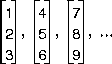
[0],[0],[0],[1],[2],[3],[4],[5],[6],[7],[8],[9],...with sample period Tfi/3.