| DSP Blockset | Search Help Desk |
| Biquadratic Filter | See Also |
Apply a cascade of biquadratic (second-order section) filters to the input.
Library
Filter Realizations, in FilteringDescription
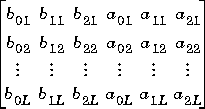
The Biquadratic Filter block applies a cascade of biquadratic filters independently to each input channel. The filter is constructed from L second-order sections, each having a quadratic numerator and denominator. The biquadratic filter is useful for reduced precision implementations because the coefficients are bounded between ±2 for typical minimum-phase designs. This reduces scaling and coefficient sensitivity problems. The SOS matrix parameter specifies the filter coefficients as a second-order section matrix of the type produced by thetf2sos and ss2sos functions in the Signal Processing Toolbox. This is an L-by-6 matrix,

ss2sos and tf2sos functions to convert a state-space or transfer-function description of the filter into the second-order section description used by this block.
The Initial conditions parameter sets the initial filter states, and can be specified in the following different forms:
[], is the same as the scalar value 0.
ic(1) and ic(2) respectively specify z-1 and z-2 for H1(z) in every channel, where ic is the initial condition vector.
ic(1,3) and ic(2,3) respectively specify z-1 and z-2 for H1(z) in the third channel, where ic is the initial condition matrix.
Sample-Based Operation
When the Frame-based inputs check box is not selected (default), the block assumes that the input is a 1-by-N sample vector or M-by-N sample matrix. Each of the N vector elements (or M*N matrix elements) is treated as an independent channel, and the block filters each channel over time.Frame-Based Operation
When the Frame-based inputs check box is selected, the block assumes that the input is an M-by-N frame matrix. Each of the N frames in the matrix contains M sequential time samples from an independent signal. The Number of channels parameter specifies the number of independent signals, N, in the matrix. The block independently applies the filter to each channel. In both sample-based and frame-based modes, the output is the same size as the input. NoteDialog Box
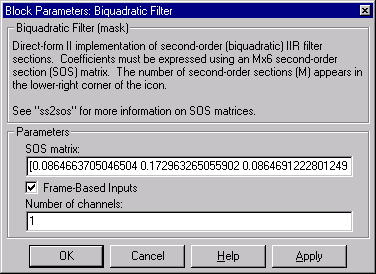
ss2sos and tf2sos.See Also
Direct-Form II Transpose Filterfilter (MATLAB)
sosfilt (Signal Processing Toolbox)
tf2sos (Signal Processing Toolbox)