| Data Acquisition Toolbox | Search Help Desk |
State Transitions
At any time, your data acquisition application can be thought of as being in a particular state. The state of an object depends on events that may have occurred. Two states are defined for the Data Acquisition Toolbox.Running property, while the logging (sending) state is given by the Logging (Sending) property. These data acquisition states and their transition paths are shown for an analog input acquisition in the figure below.
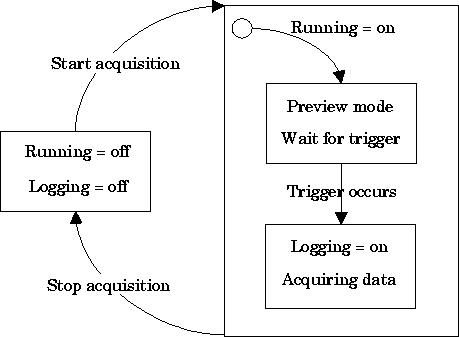
A state transition occurs when the data acquisition process transitions from one state to another due to property values that have changed. For example, a state transition occurs when your acquisition transitions from the "running" state to the "not running" state or from the "logging" state to the "not logging" state.
A state transition has the action of calling the associated action property. The value of an action property is the name of an M-file function that is to be executed when the particular state transition occurs. Action properties provide you with tremendous flexibility in defining the capabilities of your acquisition. For example, you can specify an M-file that performs a fast Fourier transform (FFT) every time a predefined amount of data is acquired. State diagrams like the one shown on page 2-20 are used throughout this book to help you visualize how data acquisition states can change based on the property values that are set. State transitions and events are described in detail in "Configuring Events and Actions" in Chapter 4.