Pairwise distance between observations.
Syntax
Y = pdist(X)
Y = pdist(X,'metric')
Y = pdist(X,'minkowski',p)
Description
Y = pdist(X) computes the Euclidean distance between pairs of objects in the data matrix X. X is an m by n matrix, treated as m vectors of size n. For a dataset made up of m objects, there are  pairs.
The output,
pairs.
The output, Y, is a vector of length  , containing the distance information. The distances are arranged in the order (1,2), (1,3),..., (1,m), (2,3),..., (2,m), ..., ...,(m-1, m).
 Y is also commonly known as a similarity matrix or dissimilarity matrix.
To save space and computation time, Y is formatted as a vector. However, you can convert this vector into a square matrix using the squareform function so that element (i,j) in the matrix corresponds to the distance between objects i and j in the original dataset.
Y = pdist(X,'metric') computes the distance between objects in the data matrix, X, using the method specified by `metric'. `metric'can be any of the following character strings that identify ways to compute the distance.
String
|
Meaning
|
`Euclid'
|
Euclidean distance (default)
|
`SEuclid'
|
Standardized Euclidean distance
|
`Mahal'
|
Mahalanobis distance
|
`CityBlock'
|
City Block metric
|
`Minkowski'
|
Minkowski metric
|
Y = pdist(X,'minkowski', p) computes the distance between objects in the data matrix, X, using the Minkowski metric. p is the exponent used in the Minkowski computation which, by default, is 2.
Mathematical Definitions of Methods .
Given an m-by-n data matrix X, which is treated as m (1-by-n) row vectors x1, x2,..., xm, the various distances between the vector xr and xs are defined as follows:
Examples
X = [1 2; 1 3; 2 2; 3 1]
X =
     1     2
     1     3
     2     2
     3     1

Y = pdist(X,'mahal')

Y =
    2.3452    2.0000    2.3452    1.2247    2.4495    1.2247

Y = pdist(X)

Y =
    1.0000    1.0000    2.2361    1.4142    2.8284    1.4142

squareform(Y)
ans =
         0    1.0000    1.0000    2.2361
    1.0000         0    1.4142    2.8284
    1.0000    1.4142         0    1.4142
    2.2361    2.8284    1.4142         0
See Also
cluster, clusterdata, cophenet, dendrogram, inconsistent, linkage, squareform
[ Previous | Help Desk | Next ]


 , which denotes the variance of the variable Xj over the m objects.
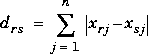
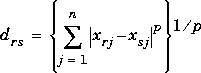
 , it is the City Block case, and when
  , it is the Euclidean case.