

groups

where:
| Statistics Toolbox | Search Help Desk |
| linkage | Examples See Also |
Create hierachical cluster tree.
Syntax
Z = linkage(Y)
Z = linkage(Y,'method')
Description
Z = linkage(Y) creates a hierarchical cluster tree, using the Single Linkage algorithm. The input matrix, Y, is the distance vector output by the pdist function, a vector of length  by 1, where m is the number of objects in the original dataset.
Z = linkage(Y,'method') computes a hierarchical cluster tree using the algorithm specified by `method'. method can be any of the following character strings that identify ways to create the cluster hierarchy. Their definitions are explained in the section, "Mathematical Definitions."| String |
Meaning |
'single' |
Shortest distance (default) |
'complete' |
Largest distance |
'average' |
Average distance |
'centroid' |
Centroid distance |
'ward' |
Incremental sum of squares |
Z, is an m-1 by 3 matrix containing cluster tree information. The leaf nodes in the cluster hierarchy are the objects in the original dataset, numbered from 1 to m. They are the singleton clusters from which all higher clusters are built. Each newly formed cluster, corresponding to row i in Z, is assigned the index m+i, where m is the total number of initial leaves.
Columns 1 and 2, Z(i,1:2), contain the indices of the objects that were linked in pairs to form a new cluster. This new cluster is assigned the index value m+i. There are m-1 higher clusters that correspond to the interior nodes of the hierarchical cluster tree.
Column 3, Z(i,3), contains the corresponding linkage distances between the objects paired in the clusters at each row i.
For example, consider a case with 30 initial nodes. If the tenth cluster formed by the linkage function combines object 5 and object 7 and their distance is 1.5, then row 10 of Z will contain the values (5,7,1.5). This newly formed cluster will have the index 10+30=40. If cluster 40 shows up in a later row, that means this newly formed cluster is being combined again into some bigger cluster.
Mathematical Definitions.
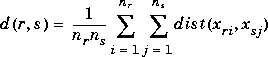
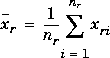
The `method' argument is a character string that specifies the algorithm used to generate the hierachical cluster tree information. These linkage algorithms are based on various measurements of proximity between two groups of objects. If nr is the number of objects in cluster r and ns is the number of objects in cluster s, and xri is the ith object in cluster r, the definitions of these various measurements are as follows:
where:
 is defined similarly.

where  is the distance between cluster r and cluster s defined in the Centroid linkage. The within-group sum of squares of a cluster is defined as the sum of the squares of the distance between all objects in the cluster and the centroid of the cluster.
Example
X = [3 1.7; 1 1; 2 3; 2 2.5; 1.2 1; 1.1 1.5; 3 1];
Y = pdist(x);
Z = linkage(y)

Z =

    2.0000   5.0000   0.2000
    3.0000   4.0000   0.5000
    8.0000   6.0000   0.5099
    1.0000   7.0000   0.7000
   11.0000   9.0000   1.2806
   12.0000  10.0000   1.3454
See Also
cluster, clusterdata, cophenet, dendrogram, inconsistent, pdist, squareform