| Statistics Toolbox | Search Help Desk |
| capable | Examples See Also |
Syntax
p = capable(data,lower,upper)
[p,Cp,Cpk] = capable(data,lower,upper)
Description
capable(data,lower,upper) computes the probability that a sample, data, from some process falls outside the bounds specified in lower and upper.
The assumptions are that the measured values in the vector, data, are normally distributed with constant mean and variance and the the measurements are statistically independent.
[p,Cp,Cpk] = capable(data,lower,upper) also returns the capability indices Cp and Cpk.
Cp is the ratio of the range of the specifications to six times the estimate of the process standard deviation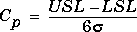 For a process that has its average value on target, a Cp of one translates to a little more than one defect per thousand. Recently many industries have set a quality goal of one part per million. This would correspond to a Cp = 1.6. The higher the value of Cp the more capable the process.
Cpk is the ratio of difference between the process mean and the closer specification limit to three times the estimate of the process standard deviation
For a process that has its average value on target, a Cp of one translates to a little more than one defect per thousand. Recently many industries have set a quality goal of one part per million. This would correspond to a Cp = 1.6. The higher the value of Cp the more capable the process.
Cpk is the ratio of difference between the process mean and the closer specification limit to three times the estimate of the process standard deviation
Example
Imagine a machined part with specifications requiring a dimension to be within three thousandths of an inch of nominal. Suppose that the machining process cuts too thick by one thousandth of an inch on average and also has a standard deviation of one thousandth of an inch. What are the capability indices of this process?data = normrnd(1,1,30,1);
[p,Cp,Cpk] = capable(data,[-3 3]);
indices = [p Cp Cpk]
indices =
0.0172 1.1144 0.7053
We expect 17 parts out of a thousand to be out-of-specification. Cpk is less than Cp because the process is not centered.
Reference
Montgomery, D., "Introduction to Statistical Quality Control," John Wiley & Sons 1991. pp. 369-374.See Also
capaplot,histfit