| Using Stateflow | Search Help Desk |
Labeling a State
The ? character is the default state label. State labels have this general format:The keywordsname/entry: during: exit: onevent_name:
entry (shorthand en), during (shorthand du), exit (shorthand ex), and on identify actions associated with the state. You can specify multiple actions by separating them by any of these:
on event_name actions for different events by adding multiple on event_name lines specifying unique values for event_name.
Each keyword is optional and positionally independent. You can specify none, some, or all of them. The colon after each keyword is required. The slash following the state name is optional as long as it is followed by a carriage return.
If you enter the name and slash followed directly by an action or actions (without the entry keyword), the action(s) is interpreted as entry action(s). This shorthand is useful if you are only specifying entry actions.
See the section titled "What Is an Action Language?" for more information on the action language.
Example: Labeling a State
This example shows the state labeling formats and explains the components of the label.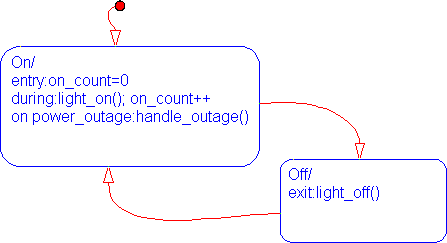
Transmission or Green_on.
The use of hierarchy provides some flexibility in the naming of states. The name that you enter as part of the label must be unique when preceded by the hierarchy of its ancestor states. The name as stored in the data dictionary consists of the text you entered as the label on the state, preceded by the hierarchy of its ancestor states separated by periods. States can have the same name appear on the graphical representation of the state, as long as the full names within the data dictionary are unique. The parser indicates an error if a state does not have a unique name entry in the data dictionary for that Stateflow diagram.
See the section titled "Example: Unique State Names" for an example of uniquely named states.
In this example, the state names are On and Off.
Entry Action.
In the example, state On has entry action on_count=0. The value of on_count is reset to 0 whenever state On's entry action is executed.
See "Semantics of State Actions" for information on how and when entry actions are executed.
During Action.
In the example, state On has two during actions light_on() and on_count++. These actions are executed whenever state On's during action is executed.
See "Semantics of State Actions" for information on how and when during actions are executed.
Exit Action.
In the example, state Off has exit action light_off(). This action is executed whenever state Off's exit action is executed.
See "Semantics of State Actions" for information on how and when exit actions are taken.
On Event_name Action.
In the example, state Off has the on event_name, power_outage. When the event power_outage occurs, the action handle_outage() is executed.
See "Semantics of State Actions" for information on how and when on event_name actions are taken.
Example: Unique State Names
This example shows how hierarchy supports unique naming of states.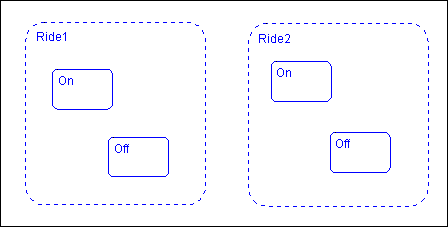
Ride1.On
Ride1.Off
Ride2.On
Ride2.Off
On and Off are duplicated, the full names are unique because of the hierarchy of the Stateflow diagram. The example intentionally contains only states for simplification purposes.