Power System Blockset
  Go to block:
    Search    Help Desk 
Excitation System    See Also

Provide an excitation system for the synchronous machine and regulate its terminal voltage in generating mode

Library

Machines Library

Description

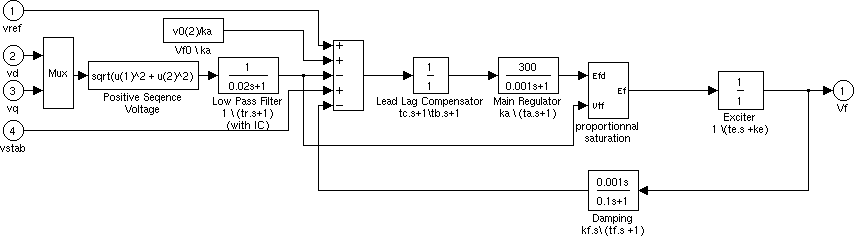
The Excitation System block is a Simulink system-implementing the DC exciter described in [1]. The basic elements that form the Excitation System block are the voltage regulator and the exciter. The voltage regulator consists of a main regulator with gain Ka and time constant Ta and a lead-lag compensator with time constants Tb and Tc. A derivate feedback is also provided with gain Kf and time constant Tf. The limits Efmin and Efmax are imposed to the output of the voltage regulator. The upper limit can be constant and equal to Efmax or variable and equal to the rectified stator terminal voltage Vtf times a proportional gain Kp. If Kp is set to zero, the former will apply. If Kp is set to a positive value, the latter will apply. The stator terminal voltage transducer is represented by a first-order low-pass filter with time constant Tr.

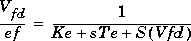
The exciter is represented by the following transfer function between the exciter voltage Vfd and the regulator's output ef:


where S(Vfd) is a nonlinear function that represents the magnetic saturation of the exciter. This saturation function is given by:



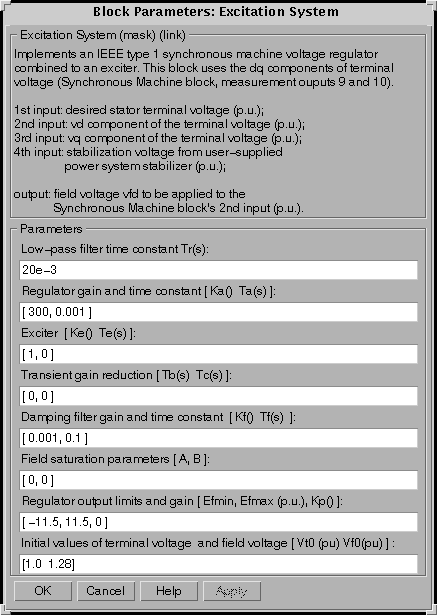
The last entry of the dialog box is used to specify the initial values of the terminal voltage and field voltage. The values used to initialize all states of the model allow you to start the simulation in steady-state.

Dialog Box

Inputs and Outputs

The first input of the block is the desired value of the stator terminal voltage. The following two inputs are the vq and vd components of the terminal voltage. The fourth input can be used to provide additional stabilization of power system oscillations. All inputs are in pu. The output of the block is the field voltage Vf for the Synchronous Machine block (p.u).

References

[1] IEEE "Recommended Practice for Excitation System Models for Power System Stability Studies". IEEE Std. 421.5-1992, August 1992

See Also

Hydraulic Turbine and Governor, Synchronous Machine
[ Previous | Help Desk | Next ]