| Power System Blockset | Search Help Desk |
| Circ2ss | Examples See Also |
Compute the state-space model of a linear electrical circuit
Synopsis
You must callcirc2ss with a minimum of seven input arguments.
[A,B,C,D,states,x0,x0sw,rlsw,u,x,y,freq,Asw,Bsw,Csw,Dsw,Hlin]=
circ2ss(rlc,switches,source,line_dist,yout,y_type,unit)
You can also specify additional arguments. To use options, the number of input arguments must be 12, 13, 14 or 16.
[A,B,C,D,states,x0,x0sw,rlsw,u,x,y,freq,Asw,Bsw,Csw,Dsw,Hlin]=
circ2ss(rlc,switches,source,line_dist,yout,y_type,unit,net_arg1,
net_arg2,net_arg3,...
netsim_flag,fid_outfile,freq_sys,options,vary_name,vary_val)
Description
Computes the state-space model of a linear electrical circuit expressed as where x is the vector of state-space variables (inductor currents and capacitor voltages), u is the vector of voltage and current inputs, and y is the vector of voltage and current outputs.
When you build a circuit from the Power System Block set icons of the powerlib library,
where x is the vector of state-space variables (inductor currents and capacitor voltages), u is the vector of voltage and current inputs, and y is the vector of voltage and current outputs.
When you build a circuit from the Power System Block set icons of the powerlib library, circ2ss is automatically called by power2sys. circ2ss has also been made available as a stand-alone function for expert users. This allows you to generate state-space models without using the Power System Blockset graphical interface and to access options that are not available through powerlib. For example, you can specify transformers and mutual inductances with more than three windings.
The linear circuit can contain any combination of voltage and current sources, RLC branches, multi-winding transformers, mutually coupled inductances, and switches. The state variables are inductor currents and capacitor voltages.
The State-Space block containing A,B,C,D and x0 matrices computed by circ2ss can then be used in a Simulink system to perform simulation of the electrical circuit. Nonlinear elements (such as mechanical or electronic switches, transformer saturation, machines, and distributed parameter lines) can be connected to the linear circuit. These Simulink models are interfaced with the linear circuit through voltage outputs and current inputs of the state-space model. You can find the models of the nonlinear elements provided with the Power System Blockset in the powerlib_models library.
Input Arguments
The number of input arguments must be 7, 12, 13, 14, or 16. Arguments 8 to 16 are optional. The first seven arguments that must be specified are (see format following):rlc : Branch matrix specifying the network topology as well as the resistance R, inductance L, and capacitance C values.
switchessourceline_distyout: String matrix of output expressions.
y_typeInteger vector indicating output types (zero for voltage output, one for current output).
unit: unit= 'OHM'freq_sys (default value is 60Hz). If unit= 'OMU', R L C values are specified in ohms, millihenries (mH) and microfarads (µF).
power2sys function. Hereafter, we describe only the arguments to be specified when circ2ss is used as a stand-alone function.
net_arg1, net_arg2 net_arg3: Used to pass arguments from power2sys. Specify empty variables [] for each of these variables.
netsim_flag: Integer controlling the messages displayed during the execution of circ2ss. Default value is zero, no output file is produced.
If netsim_flag =0, the version number, number of states, inputs, outputs and modes are displayed. Output values are displayed in polar form for each source frequency.
If netsim_flag=1, only version number, number of states, inputs and outputs are displayed.
If netsim_flag=2, no message is displayed during execution.
fid_outfilecirc2ss output file containing parameter values, node numbers, steady-state outputs, and special messages. Default value is zero.
freq_sys unit is set to 'OHM'. Default value is 60 Hz.
options: Integer vector specifying five options. Default values are [0 0 0 0 0].
option(1) : Reference node number used for ground of pi transmission lines. If -1 is specified, the user will be prompted to specify a node number.
option(2): Specify normalization of A B C D matrices in order to use the per-unit system. This option is not available from power2sys. There is no normalization if option(2)=0. If option(2)=1 cir2ss will use per-unit system. The base voltage and base power are specified by option(3) and option(4). If option(2)=-1 the user will be prompted to specify a base voltage and a base power.
option(3): Base voltage (kVrms Phase-Phase)
option(4): Base power (MVA 3 phase)
option(5): Enter 0
vary_name: String matrix containing the symbolic variable names used in output expressions. These variables must be defined in your MATLAB workspace.
vary_valvary_name.
Output Arguments
A,B,C,Dnstates, nstates), B (nstates, ninput), C (noutput, nstates), D (noutput, ninput) where nstates is the number of state variables, ninput is the number of inputs, and noutput is the number of outputs.
statesIl_bxx_nzz1_zz2
-Capacitor voltages: Uc_bxx_nzz1_zz2 -xx = branch number-zz1= 1st node number of the branch-zz2 = 2nd node number of the branch
states matrix, which are followed by an asterisk, indicate inductor currents and capacitor voltages which are not considered as state variables. This situation arises when inductor currents or capacitor voltages are not independent (inductors in series or capacitors forming a loop). The currents and voltages followed by an asterisk can be expressed as a linear combination of the other state variables:
x0: Column vector of initial values of state variables considering the open or closed status of switches
x0sw: Vector of initial values of switch currents
rlsw: Matrix (nswitch,2) containing the R and L values of series switch impedances in Ohm and Henry. nswitch is the number of switches in the circuit.
u,x,y: Matrices u(ninput, nfreq), x (nstates, nfreq) and y (noutput, nfreq) containing the steady-state complex values of inputs, states, and outputs. nfreq is the length of the freq vector. Each column corresponds to a different source frequency, as specified by the next argument freq.
freq: Column vector containing the source frequencies ordered by increasing frequencies
Asw,Bsw,Csw,Dsw: State-space matrices of the circuit including the closed switches. Each closed switch adds one extra state to the circuit.
Hlin: Three dimension array (nfreq, noutput, ninput) of the nfreq complex transfer impedance matrices of the linear system corresponding to each frequency of the freq vector
Format of the RLC Input Matrix
Two formats are allowed:Nobr variable is imposed by the user.
RLC matrix must be specified according to the following format:
[node1, node2, type, R, L, C, Nobr] for RLC or line branch[node1, node2, type, R, L, C, Nobr] for transformer magnetizing branch[node1, node2, type, R, L, U, Nobr] for transformer winding[node1, node2, type, R, L, U, Nobr] for mutual inductances
node1: First node number of the branch. The node number must be positive or zero. Decimal node numbers are allowed.
node2: Second node number of the branch. The node number must be positive or zero. Decimal node numbers are allowed.
type: Integer indicating the type of connection of RLC elements, or the transmission line length (negative value).
type=0: Series RLC element,
type=1: Parallel RLC element
type=2: Transformer winding
type=3: Coupled (mutual) winding
If type is negative value: transmission line modeled by a PI section. See details below.
rlc matrix:
type=2 or type=3; (one line per winding). Each line specifies
R/L/U or R/Xl/Xc, where [R/L, R/Xl] = winding resistance and leakage
reactance for a transformer or winding resistance and self reactance for
mutually coupled windings. U is the nominal voltage of transformer
winding (specify 0 if type =3).
type=1 for the magnetizing branch of a transformer
(parallel Rm/Lm or Rm/Xm) or one line with type=0 for a mutual impedance
(series Rm/Lm or Rm/Xm).
Lm/Xm value to zero (no linear inductance) and use the transfosat block with proper flux-current characteristic. This block can be found in the powerlib_models library. This block must be connected to the State-Space block between a voltage output (voltage across the magnetizing branch and a current input (current source injected into the transformer internal node). See the example given at the end of the Circ2ss documentation.
If type is a negative value: length (km) of a transmission line simulated by a PI section. R: Branch resistance (ohms or pu)
Xl: Branch inductive reactance (ohms or pu at freq_sys) or transformer winding leakage reactance (ohms)
L: Branch inductance (mH)
Xc: Branch capacitive reactance (ohms or pu at freq_sys) (The negative sign of Xc is optional)
C: Capacitance (µF)
U: Nominal voltage of transformer winding. Same units Volts or kV must be used for each winding. For a mutual inductance (type=3), this value must be set to zero.
Zero values for R, L or Xl, C or Xc in a series or parallel branch indicate that the corresponding element does not exist.
1e-6 pu, based on rated voltage and power) to simulate a quasi ideal transformer. The leakage reactances can be set to zero. The resistive part of the magnetizing branch Rm of a transformer must have a finite value. Specify a very high value (low losses, e.g, Rm=1e4 pu or 0.01% current based on rating) to simulate a quasi ideal transformer. The inductive part of the magnetizing branch can be set to infinite (No reactive losses; specify Xm=0). A null value is not allowed for the mutual inductance of coupled windings. The resistive part of series mutual branch can be set to zero.
Format of the SOURCE Input Matrix
Three formats are allowed:freq_sys
[node1, node2, type, amp, phase, freq, model]
node1, node2: Node numbers corresponding to the source terminals Polarity conventions: Voltage source: node1 is the positive terminal. Current source: Positive current flowing from node1 to node2 inside the source.
type: Integer indicating the type of source: 0 for voltage source; 1 for current source
amp: Amplitude of the AC or DC voltage or current (V, A or pu)
phase: Phase of the AC voltage or current (degree)
freq: Frequency (Hz) of the generated voltage or current. Default value is 60 Hz. For a DC voltage or current source specify phase=0 and freq=0. amp can be set to a negative value. The generated signals are: amp*sin(2*pi*freq*t+phase) for AC, amp for DC.
model: Integer specifying the type of nonlinear element modeled by the current source (saturable inductance, thyristor, switch. . .). Used by power2sys only.
Format of the SWITCHES Input Matrix
Switches are nonlinear elements simulating mechanical or electronic devices such as circuit breakers diodes or thyristors. As for other nonlinear elements, they are simulated by current sources driven by the voltage appearing across their terminals. Therefore, they cannot have a perfectly zero impedance. They are simulated as ideal switches in series with a series R-L circuit. Various models of switches (circuit breaker, ideal switch, and power electronic devices) are available in the powerlib_models library. They must be interconnected to the State-Space block through appropriate voltage outputs and current inputs. The switch parameters must be specified in a line of the Switches matrix in seven different columns according to the following format:[node1, node2, status, R, L/Xl, no_I, no_U]
node1, node2: Node numbers corresponding to the switch terminals,
status: Code indicating the initial status of the switch at t=0
0= open1= closed
R: Resistance of the switch when closed (ohms or pu)
L/Xl: Inductance of the switch when closed (mH) or inductive reactance (ohms or pu at freq_sys).
rlc matrix must be used. Null inductance values are not allowed. However, the resistance can be set to zero.
The next two fields specify the current input number and the voltage output number to be used for interconnecting the switch model to the state-space block.
no_I: Current input number coming from the output of the switch model.
no_U: Voltage output number driving the input of the switch model.
Format of the LINE_DIST Matrix
The distributed parameter line model contains two parts:nphase line, the first (4+3*nphase+nphase^2) columns are used. For example, for a three-phase line, 22 columns are used.
[nphase, no_I, no_U, long, L/Xl, Zc, Rm, speed, Ti]
nphase: Number of phases of the transmission line.
no_I: Input number in the source matrix corresponding to the first current source Is_1 of the line model. Each line model uses 2*nphase current sources specified in the source matrix as follows:
Is_1 Is_2...Is_nphase for the sending end followed by
Ir_1 Ir_2...Ir_nphase for the receiving end.
no_U: Output number of the state-space corresponding to the first voltage output Vs_1 feeding the line model. Each line model uses 2*nphase voltage outputs in the source matrix as follows:
Vs_1 Vs_2...Vs_nphase for the sending end followed by
Vr_1 Vr_2...Vr_nphase for the receiving end.
long: Length of the line (km)
Zc: Vector of the nphase modal characteristic impedances (ohms)
Rm: Vector of the nphase modal series linear resistances (ohms/km)
speed: Vector of the nphase modal propagation speeds (km/s)
Ti: Transformation matrix from mode to phase currents such that Iphase=Ti.Imod. The nphase*nphase matrix must be given in vector format[col_1, col_2,... col_nphase].
Format of the YOUT Matrix
The desired outputs are specified by a string matrixyout. Each line of the yout matrix must be an algebraic expression containing a linear combination of states and state derivatives specified according the following format:
Uc_bn: Capacitor voltage of branch #n
Il_bn: Inductor current of branch #n
dUc_bn,dIl_bn: Derivative of Uc_bn or Il_bn
Un, In: Source voltage or current specified by line #n of the source matrix
U_nx1_x2: Voltage between node x1 and node x2
I_bn: Current in branch #n. For a parallel RLC branch, I_bn corresponds to the total current IR+IL+IC
I_bn_nx: Current flowing into node x of a pi transmission line specified by line #n of the rlc matrix. (This current includes the series inductive branch current and the capacitive shunt current).
(+-*/^). For example:
yout =
str2mat(['R1*I_b1+Uc_b3-L2*dIl_b2','U_n10_20','I2+3*I_b5']);
R1 and L2 in the above example), their names and values must be specified by the two input arguments vary_name and vary_val.
Sign Conventions for Voltages And Currents
I_bn Il_bn, In: Branch current, inductor current of branch #n or current of source #n is oriented from node1 to node2.
I_bn_nx: Current at one end (node x) of a pi transmission line. If x = node1, the current is entering the line. If x = node2, the current is going out of the line.
Uc_bn, Un: Voltage across capacitor or source voltage (Unode1 - Unode2)
U_nx1_x2: Voltage between nodes x1 and x2 = Ux1 - Ux2. Voltage of node x1 with respect to node x2.
Example
The following circuit consists of two sources (one voltage source and one current source), two series RLC branches (R1-L1 and C6), two parallel RLC branches (R5-C5 and L7-C7), one saturable transformer and two switches (Sw1 and Sw2). Sw1 is initially closed whereas Sw2 is initially open. Three measurement outputs are specified (I1,V2 and V3). This circuit has seven nodes numbered 0, 1, 2, 2.1, 10, 11 and 12. Node 0 is used for the ground. Node 2.1 is the internal node of the transformer where the magnetization branch is connected.
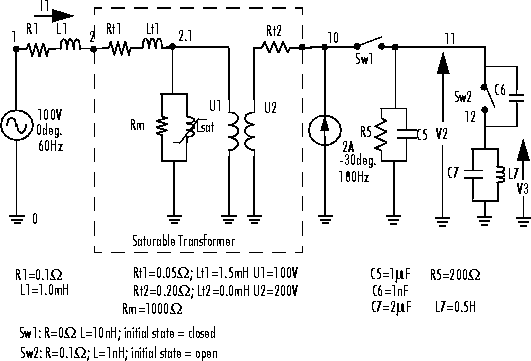
You can use the circ2ss function to find the state-space model of the linear part of the circuit. The nonlinear elements Sw1,Sw2 and Lsat must be modeled separately by means of current sources driven by the voltage appearing across their terminals. Therefore you must foresee three additional currents sources and three additional voltage outputs for interfacing the nonlinear elements to the linear circuit.
psbcirc2ss.m file.
unit=While'OMU'% specifies units : Ohms mH uF rlc=[ %node1 node2 typeR L C(uF)/U(V) 1 2 0 0.1 1 0%R1 L1 2 0 2 0.05 1.5 100%transfo Wind.#1 10 0 2 0.20 0 200%transfo Wind.#2 2.1 0 1 1000 0 0%transfo mag.branch 11 0 1 200 0 1%R5 C5 11 12 0 0 0 1e-3%C6 12 0 1 0 500 2%L7 C7 ]; source=[ %node1 node2 typeU/I phasefreq 1 0 0 100 0 60 % Voltage source 0 10 1 2 -30 180% Current source 2.1 0 1 0 0 0% Saturation 10 11 1 0 0 0% Sw1 11 12 1 0 0 0% Sw2 ]; switches=[ %node1 node2 status R(ohm) L(mH)I#U# 10 11 1 0 10e-6 42% Sw1 11 12 0 0.1 1e-6 53% Sw2 ]; % outputs %========= y_u1='U_n2.1_0'; %U_sat= Saturable reactor voltage y_u2='U_n10_11'; %U_Sw1= Voltage across Sw1 y_u3='U_n11_12'; %U_Sw2= Voltage across Sw2 y_i4='I_b1'; %I1 measurement y_u5='U_n11_0'; %V2 measurement y_u6='U_n12_0'; %V3 measurement yout=str2mat(y_u1,y_u2,y_u3,y_i4,y_u5,y_u6); %outputs y_type=[0,0,0,1,0,0]; %output type 0=voltage 1=current [A,B,C,D,states,x0,x0sw,rlsw,u,x,y,freq,... Asw,Bsw,Csw,Dsw,Hlin]=... circ2ss(rlc,switches,source,[],yout,y_type,unit);
circ2ss is executing, the following messages are displayed:
Computing state-space representation of linear electrical
circuit...
(4 states ; 5 inputs ; 6 outputs)
Oscillatory modes and damping factors:
F=159.115Hz zeta=4.80381e-008
Steady state outputs @ F=0 Hz :
y_u1= 0Volts
y_u2= 0Volts
y_u3= 0Volts
y_i4= 0Amperes
y_u5= 0Volts
y_u6= 0Volts
Steady state outputs @ F=60 Hz :
y_u1= 99.81Volts < -1.144 deg.
y_u2= 3.77e-006Volts < 93.17 deg.
y_u3= 199.4Volts < -1.148 deg.
y_i4= 2.099Amperes < 2.963 deg.
y_u5= 199.4Volts < -1.148 deg.
y_u6= 0.01652Volts < 178.9 deg.
Steady state outputs @ F=180 Hz :
y_u1= 11.4Volts < 53.48 deg.
y_u2= 1.324e-006Volts < 155.2 deg.
y_u3= 22.78Volts < 52.47 deg.
y_i4= 4.027Amperes < 146.5 deg.
y_u5= 22.83Volts < 52.47 deg.
y_u6= 0.0522Volts < 52.47 deg.
The names of the state variables are returned in the
states string matrix:
states =
Il_b2_n2_2.1
Uc_b5_n11_0
Uc_b6_n11_12
Il_b7_n12_0
Il_b1_n1_2*
Uc_b7_n12_0*
Although this circuit contains six inductors and capacitors, there are only four state variables. The names of the state variables are given by the first four lines of the
states matrix. The last two lines are followed by an asterisk indicating that these two variables are a linear combination of the state variables:
The A,B,C,D matrices contain the state-space model of the circuit without nonlinear elements (sw1 switch open). The x0 vector contains the initial state values considering the switch sw1 closed. The Asw, Bsw, Csw, Dsw matrices contain the state-space model of the circuit considering the closed switch sw1. In our example, the system contains an extra state corresponding to the current flowing into the Sw1 inductor. TheUc_b7_n12_0 = + Uc_b5_n11_0 - Uc_b6_n11_12Il_b1_n1_2 = + Il_b2_n2_2.1
xosw vector contains the initial current in the closed switch.
A =
-4.0006e+005      0           0      0
-1.8998e-008     -4995        0     -499.25
 1.8998e-005     -4992.5      0      4.9925e+005
 0                2          -2      0
Asw =
-4.0006e+005      0           0      08e+005
-1.8998e-008     -4995        0     -499.259.99e+005
 1.8998e-005     -4992.5      0      4.9925e+0059.985e+005
 0                2          -2      0
 2e+011          -1e+008      0     -4.0002e+011
The system source frequencies are returned in the freq vector:
freq =
     0    60   180
The corresponding steady-state complex outputs are returned in the (6x3) y matrix where each column corresponds to a different source frequency.
For example, you can obtain the magnitude of the six voltage and current outputs at 60Hz as follows:
abs(y(:,2))
ans =
 99.808
  3.7696e-006
199.43
  2.0994
199.42
  0.01652
x0 =
 2.3303
14.113
14.071
 3.1393e-005
The initial values of switch currents are returned in x0sw. To start the simulation in steady-state, you must use these values as initial currents for the nonlinear model simulating the switches.
x0sw =
0.16155
0
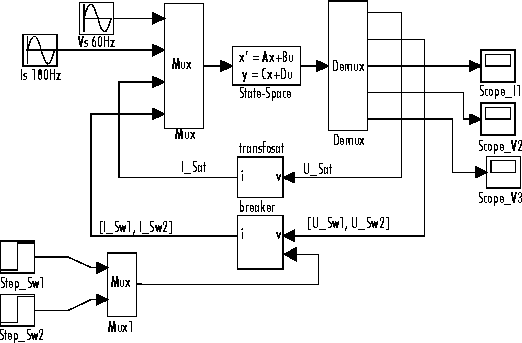
The Simulink model of the circuit is shown in the following figure. If you had used the powerlib library to build your circuit, the same Simulink system would have been generated automatically by the
power2sys function. The corresponding version of this circuit built with the Power System Blockset is available in the psbcirc2ss_slk.mdl file.
The linear part of the circuit is simulated by the State-Space block. Appropriate inputs and outputs are used to connect the switch and saturable reactance models to the linear system. You can find the breaker and transfosat blocks in the powerlib_models library containing all the nonlinear models used by the Blockset. As the breaker model is vectorized, a single block is used to simulate the two switches Sw1 and Sw2.
See Also
power2sys