| Optimization Toolbox | Search Help Desk |
| linprog | Examples See Also |
Solve a linear programming problem
Syntax
x = linprog(f,A,b,Aeq,beq)
x = linprog(f,A,b,Aeq,beq,lb,ub)
x = linprog(f,A,b,Aeq,beq,lb,ub,x0)
x = linprog(f,A,b,Aeq,beq,lb,ub,x0,options)
[x,fval] = linprog(...)
[x,fval,exitflag] = linprog(...)
[x,fval,exitflag,output] = linprog(...)
[x,fval,exitflag,output,lambda] = linprog(...)
Description
linprog solves linear programming problems.
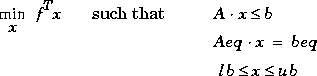
x = linprog(f,A,b)
solves min f'*x such that A*x <= b.
x = linprog(f,A,b,Aeq,beq)
solves the problem above while additionally satisfying the equality constraints Aeq*x = beq. Set A=[] and b=[] if no inequalities exist.
x = linprog(f,A,b,Aeq,beq,lb,ub)
defines a set of lower and upper bounds on the design variables, x, so that the solution is always in the range lb <= x <= ub. Set Aeq=[] and beq=[] if no equalities exist.
x = linprog(f,A,b,Aeq,beq,lb,ub,x0)
sets the starting point to x0. This option is only available with the medium-scale algorithm (options.LargeScale is 'off'). The default large-scale algorithm will ignore any starting point.
x = linprog(f,A,b,Aeq,beq,lb,ub,x0,options)
minimizes with the optimization parameters specified in the structure options.
[x,fval] = linprog(...)
returns the value of the objective function fun at the solution x: fval = f'*x.
[x,lambda,exitflag] = linprog(...)
returns a value exitflag that describes the exit condition.
[x,lambda,exitflag,output] = linprog(...)
returns a structure output that contains information about the optimization.
[x,fval,exitflag,output,lambda] = linprog(...)
returns a structure lambda whose fields contain the Lagrange multipliers at the solution x.
Arguments
The arguments passed into the function are described in Table 1-1. The arguments returned by the function are described in Table 1-2. Details relevant tolinprog are included below for options, exitflag, lambda, and output.Examples
Findx that minimizes 
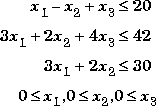
f = [-5; -4; -6]
A =  [1 -1  1
      3  2  4
      3  2  0];
b = [20; 42; 30];
lb = zeros(3,1);
Next, call a linear programming routine:
[x,fval,exitflag,output,lambda] = linprog(f,A,b,[],[],lb);Entering
x, lambda.ineqlin, and lambda.lower gets
x =
     0.0000
    15.0000
     3.0000
lambda.ineqlin =
     0
     1.5000
     0.5000
lambda.lower =
     1.0000
     0
     0
Nonzero elements of the vectors in the fields of lambda indicate active constraints at the solution. In this case, the second and third inequality constraints (in lambda.ineqlin) and the first lower bound constraint (in lambda.lower) are active constraints (i.e., the solution is on their constraint boundaries).
Algorithm
Large-scale optimization. The large-scale method is based on LIPSOL ([3]), which is a variant of Mehrotra's predictor-corrector algorithm ([2]), a primal-dual interior-point method. A number of preprocessing steps occur before the algorithm begins to iterate. See the linear programming section in the Large-Scale Algorithms chapter. Medium-scale optimization.linprog uses a projection method as used in the quadprog algorithm. linprog is an active set method and is thus a variation of the well-known simplex method for linear programming [1]. It finds an initial feasible solution by first solving another linear programming problem.
Diagnostics
Large-scale optimization. The first stage of the algorithm may involve some preprocessing of the constraints (see the "Large-Scale Linear Programming" section of the Large-Scale Algorithms chapter). Several possible conditions might occur that causelinprog to exit with an infeasibility message. In each case, the exitflag argument returned by linprog will be set to a negative value to indicate failure.
If a row of all zeros is detected in Aeq but the corresponding element of beq is not zero, the exit message is
Exiting due to infeasibility:   an all zero row in the constraint
matrix does not have a zero in corresponding right hand size
entry.
If one of the elements of
x is found to not be bounded below, the exit message is
Exiting due to infeasibility: objective f'*x is unbounded below.If one of the rows of
Aeq has only one nonzero element, the associated value in x is called a singleton variable. In this case, the value of that component of x can be computed from Aeq and beq. If the value computed violates another constraint, the exit message is
Exiting due to infeasibility: Singleton variables in equality
constraints are not feasible.
If the singleton variable can be solved for but the solution violates the upper or lower bounds, the exit message is
Exiting due to infeasibility: singleton variables in the equality
constraints are not within bounds.
Note:
One or more of the residuals, duality gap, or total relative error
has grown 100000 times greater than its minimum value so far:
or
One or more of the residuals, duality gap, or total relative error
has stalled:
After one of these messages displays, it will be followed by one of the following six messages indicating if it appears the dual, the primal, or both are infeasible. The messages differ according to how the infeasibility or unboundedness was measured.
The dual appears to be infeasible (and the primal unbounded).(The
primal residual < TolFun)
The primal appears to be infeasible (and the dual unbounded). The
dual residual < TolFun)
The dual appears to be infeasible (and the primal unbounded) since
the dual residual > sqrt(TolFun).(The primal residual <
10*TolFun)
The primal appears to be infeasible (and the dual unbounded) since
the primal residual > sqrt(TolFun).(The dual residual <
10*TolFun)
The dual appears to be infeasible and the primal unbounded since
the primal objective < -1e+10 and the dual objective < 1e+6.
The primal appears to be infeasible and the dual unbounded since
the dual objective > 1e+10 and the primal objective > -1e+6.
Both the primal and the dual appear to be infeasible.Note that, for example, the primal (objective) can be unbounded and the primal residual, which is a measure of primal constraint satisfaction, can be small. Medium-scale optimization.
linprog gives a Warning: The constraints are overly stringent; there is no feasible solution.In this case,
linprog produces a result that minimizes the worst case constraint violation.
When the equality constraints are inconsistent, linprog gives
Warning: The equality constraints are overly
stringent; there is no feasible solution.
Unbounded solutions result in the warning
Warning: The solution is unbounded and at infinity;
the constraints are not restrictive enough
In this case,
linprog returns a value of x that satisfies the constraints.
Limitations
Medium-scale optimization. At this time, the only levels of display, using theDisplay parameter in options, are 'off' and 'final'; iterative output using 'iter' is not available.
See Also
quadprog
References
[1] Dantzig, G.B., A. Orden, and P. Wolfe, "Generalized Simplex Method for Minimizing a Linear from Under Linear Inequality Constraints," Pacific Journal Math. Vol. 5, pp. 183-195. [2] Mehrotra, S., "On the Implementation of a Primal-Dual Interior Point Method," SIAM Journal on Optimization, Vol. 2, pp. 575-601, 1992. [3] Zhang, Y., "Solving Large-Scale Linear Programs by Interior-Point Methods Under the MATLAB Environment," Technical Report TR96-01, Department of Mathematics and Statistics, University of Maryland, Baltimore County, Baltimore, MD, July 1995.