Plot pole/zero pattern (maybe with confidence ellipses) of estimated transfer function.
Syntax
plotelpz(pdat)
[rnum,rdenom] =...
    plotelpz(pdat,axv,cdat,Pc,ntx,parr,zarr,domain,da,dp,plm)
Description
plotelpz plots pole/zero pattern of the transfer function defined by the parameter vector pdat or by the named file if pdat is a string.
The scaling may be modified by axv: if this is a four-element vector, it will be passed through axis; if this is 'z', the statement axis([-2,2,-2,2]) will be executed; and if this is 'p', the plot will show all poles and zeros, and the vertical and the horizontal scaling will be the same. If axv is empty or missing, the plot will be scaled to show every pole and zero.
cdat is the covariance matrix (array), or the covariance vector (see expcov), or the name of the file containing the covariance matrix of the estimated parameters. It is used for the plot of the uncertainty ellipses.
The standard deviations of poles and zeros are calculated using stdpz.
The routine plots the "one- " contours as uncertainty ellipses. This can be modified by
 Pc which determine the multiplier of for the contours. It is easy to see that, supposing two-dimensional nondegenerate normal distribution, the confidence limit for the event that the pole (zero) falls inside the contour is 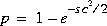 with
with sc being the multiplier of . This expression gives the following values:
sc
|
p
|
degenerate p
|
1.0
|
0.39
|
0.68
|
1.5
|
0.68
|
0.866
|
2.0
|
0.86
|
0.954
|
2.5
|
0.96
|
0.988
|
3.0
|
0.989
|
0.9973
|
3.5
|
0.9978
|
0.99953
|
4.0
|
0.99966
|
0.999937
|
if 0 < Pc < 1, Pc will be interpreted as the confidence level p. If Pc > 1, its value will be assigned to sc.
In the degenerate cases (one-dimensional distribution, as for real poles and zeros, or for certain constraints) the ellipses reduce to straight lines, and are represented by narrow "strips" on the plots. In such cases the probabilities can be calculated from the normal distribution (see third column).
The plot of uncertainty ellipses does not provide information about coupling of poles and zeros. Such couplings can be explored using the routine stdpz.
For multiple zeros/poles the analytical sensitivity calculations give infinite standard deviations: in such cases dotted rectangulars are plotted instead of ellipses around the multiple zeros/poles.
By the help of the string argument ntx, the plot style can be modified. If it is given with the value 'notext', no text at all will be written onto the plot; if with the value 'nomsg', the warning messages will be suppressed only.
A set of poles and zeros each can also be given in the arrays parr and zarr, accompanied by the domain ('s' or 'z'). These sets can also be plotted in addition to or instead of the zeros and poles given in pdat.
plotelpz can pass some arguments to stdpz: da, dp and plm can influence the calculation mode (see stdpz).
The output arguments rnum and rdenom are the row vectors of the poles and zeros, calculated from pdat. They are exported from plotelpz to avoid the necessity of repeated use of roots, if the order is large.
plotelpz can be used as a building block of complex M-files, especially with the 'notext' option. It does not even change the state of the graphics window, previously set by the subplot or axes statement, if ntxt is given as 'notext' or 'nomsg'.
A typical plot of plotelpz is shown in the figure.
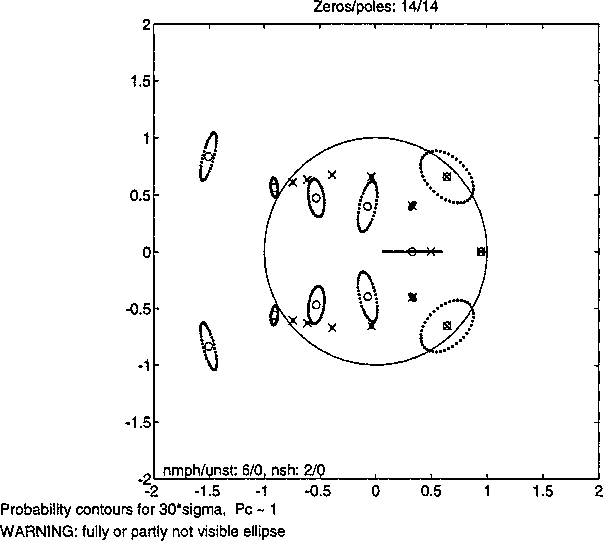 The numbers of poles and zeros, the numbers of non-minimal phase zeros and unstable poles are given on the plot, along with the number of zeros/poles not shown because of the axis scaling applied. If any of the uncertainty ellipses is so large that less than 10 points of the dotted line can be shown on the plot, a warning message appears at the lower left corner:
WARNING: fully or partly not visible ellipse
Default Argument Values
axv = [], Pc = 0.39 (sc = 1), ntx = '', da = 'anal', dp = 1, plm = ''.
Examples
plotelpz('inpchanz.pbn','z');
[rnum,rdenom] = plotelpz('inpchans.pbn',[],'inpchans.cbn');
Algorithm
The calculation of the poles/zeros is done by roots. The determination of the uncertainty ellipses is rather involved. The covariances of the real and imaginary parts of the poles/zeros are calculated by linear transformation from the covariance matrix of the parameters, using the sensitivity matrix (see stdpz).
See Also
stdpz, roots, ploteltf
References
[1] P. Guillaume, J. Schoukens and R. Pintelon, "Sensitivity of Roots to Errors in the Coefficient of Polynomials Obtained by Frequency-Domain Estimation Methods," IEEE Trans. on Instrumentation and Measurement, Vol. 38, No. 6, pp. 1050-1056, Dec. 1989.
[ Previous | Help Desk | Next ]