| DSP Blockset | Search Help Desk |
Benefits of Frame-Based Processing
Frame-based processing is an established method of accelerating both real-time systems and simulations.Accelerating Real-Time Systems
Framed data is a common format in real-time systems, where the data acquisition hardware often operates by accumulating a large number of signal samples at a high rate, and propagating these samples to the real-time system as a block of data. This maximizes the efficiency of the system by distributing fixed process overhead across many samples; the "fast" data acquisition is interrupted by "slow" interrupt processes after each frame is acquired, rather than after each individual sample. The figure below illustrates how throughput is increased by frame-based data acquisition. The thin blocks each represent the time elapsed during acquisition of a sample. The thicker blocks each represent the time elapsed during the interrupt service routine (ISR) that reads the data from the hardware. In this example, the frame-based operation acquires a frame of 16 samples between each ISR. The frame-based throughput rate is therefore many times higher than the sample-based alternative.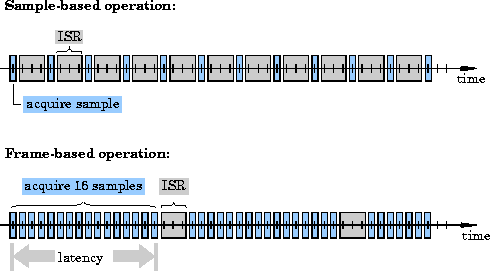
It's important to note that frame-based processing introduces a certain amount of latency into a process due to the inherent lag in buffering the initial frame. In most instances, however, it is possible to select frame sizes that improve throughput without creating unacceptable latencies.
Accelerating Simulations
Simulation also benefits from frame-based processing. In this case, it is the overhead of block-to-block communications that is reduced by propagating frames rather than individual samples.