| DSP Blockset | Search Help Desk |
How to Use This Guide
This book contains tutorial sections that are designed to help you become familiar with using Simulink and the DSP Blockset, as well as a reference section for finding detailed information on particular blocks in the blockset.Technical Conventions
Vectors. In this book, and in the block dialog boxes, the terms width and length are used interchangeably to describe the size of a vector, buffer, or frame:When a vector represents a frame of data (frame vector), it is usually shown as a column vector with the most recent sample in the last position,u = [1 2 3 4 5]% a vector of length N=5u = 1:25% a buffer of width 25 u = [1:64]' % a length-64 frame
u(end). When a vector represents data from multiple channels (sample vector), it is usually shown as a row vector with the first channel in the leftmost position, u(1).
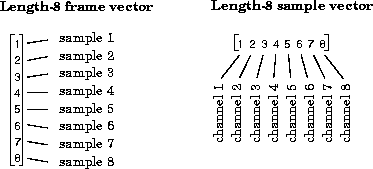
See "Understanding Matrices" and "Understanding Samples and Frames" in Chapter 2 for more information about these different representations.
Matrices. Matrix dimensions are described in terms of the number of rows and the number of columns of the matrix:u = [1 2 3;4 5 6] % a 2-by-3 matrixThe number of channels in a frame-based matrix is the number of columns. Arrays. The number of pages of a three-dimensional array (in the MATLAB workspace) refers to the size of its third dimension:
A(:,:,1) = [1 2 3;4 5 6]     % the first page of a 3-page array
A(:,:,2) = [7 8 9;0 1 2]     % the second page
A(:,:,3) = [3 4 5;6 7 8]     % the last page
Important sampling-related notational conventions are listed in "Understanding Sample Rates" in Chapter 2.
Typographical Conventions