| Control System Toolbox | Search Help Desk |
| rlocfind | Examples See Also |
Select feedback gain from root locus plot
Syntax
[k,poles] = rlocfind(sys)
[k,poles] = rlocfind(sys,p)
Description
rlocfind
rlocfind works with both continuous- and discrete-time SISO systems.
[k,poles] = rlocfind(sys)
is used for interactive gain selection from the root locus plot of the SISO system sys generated by rlocus. The function rlocfind puts up a crosshair cursor on the root locus plot that you use to select a particular pole location. The root locus gain associated with this point is returned in k and the column vector poles contains the closed-loop poles for this gain. To use this command, the root locus of the SISO open-loop model sys must be present in the current figure window.
[k,poles] = rlocfind(sys,p)
takes a vector p of desired root locations and computes a root locus gain for each of these locations (that is, a gain for which one of the closed-loop roots is near the desired location). The jth entry of the vector k gives the computed gain for the pole location p(j), and the jth column of the matrix poles lists the resulting closed-loop poles.
Example
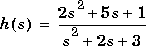
Determine a feedback gain such that the closed-loop poles of the system
 = 0.707.
h = tf([2 5 1],[1 2 3]); rlocus(h) % Plot the root locus k = rlocfind(h) % Select pole with
Algorithm
[k,poles] = rlocfind(sys,p) calculates the gaink from the following formula.
k = abs(d(p)/n(p))where p is the complex point you supply as an input argument to rlocfind (or where you point to with the mouse), and
n and d are respectively the numerator and denominator polynomials of the transfer function associated with sys. The poles associated with the gain k are then computed as
poles = roots(k*n(s) + d(s))
Limitations
rlocfind assumes that a root locus is in the current figure window when this function is called without second input argument.
See Also
rlocus rltool Root Locus Design GUI
References
[1] Ogota, K., Modern Control Engineering, Prentice Hall, 1970.