 so
so 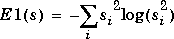
with the convention 0log(0) = 0.
 p < 2.


so
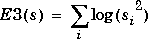
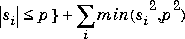
See the section entitled "Using wavelet packets for compression and de-noising" in Chapter 6 for more information.
| Wavelet Toolbox | Search Help Desk |
| wentropy | Examples |
E = wentropy(X,T,P)
E = wentropy(X,T)
E = wentropy(X,T,P) returns the entropy E of the vector or matrix input X. In both cases, output E is a real number. T is a string containing the type of entropy:
T = 'shannon', 'threshold', 'norm', 'log energy', 'sure', 'user'
P is an optional parameter depending on T value:
If T = 'shannon' or 'log energy', P is not used.
If T = 'threshold' or 'sure', P is the threshold and must be a positive number.
If T = 'norm', P is the power and must be such that 1 <= P < 2.
If T = 'user', P is a string containing the M-file name of your own entropy function, with a single input X.
E = wentropy(X,T) is equivalent to E = wentropy(X,T,0).
Functionals verifying an additive-type property are well suited for efficient searching of binary-tree structures and the fundamental splitting property of the wavelet packets decomposition. Classical entropy-based criteria match these conditions and describe information-related properties for an accurate representation of a given signal. Entropy is a common concept in many fields, mainly in signal processing. The following example lists different entropy criteria, many others are available and can be easily integrated. In the following expressions s is the signal and (si)i the coefficients of s in an orthonormal basis.
The entropy E must be an additive cost function such that E(0) = 0 and 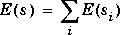 so
so with the convention 0log(0) = 0.
p < 2.
so
See the section entitled "Using wavelet packets for compression and de-noising" in Chapter 6 for more information.
% Generate initial signal.
    x = randn(1,200);

% Compute Shannon entropy of x.
    e = wentropy(x,'shannon')

e =
    -142.7607

% Compute log energy entropy of x.
    e = wentropy(x,'log energy')
e =
    -281.8975

% Compute threshold entropy of x
% with threshold equal to 0.2.
    e = wentropy(x,'threshold',0.2)
e =
    162

% Compute Sure entropy of x
% with threshold equal to 3.
    e = wentropy(x,'sure',3)
e =
 -0.6575

% Compute norm entropy of x with power equal to 1.1.
    e = wentropy(x,'norm',1.1)
e =
 160.1583

% Compute user entropy of x with a user defined
% function: userent for example.
% this function must be an M-file, with first line
% of the following form:
%
%     function e = userent(x)
%
% where x is a vector and e is a real number.
% Then a new entropy is defined and can be used typing:
%
% e = wentropy(x,'user','userent')
R.R. Coifman, M.V. Wickerhauser, (1992), "Entropy-based Algorithms for best basis selection," IEEE Trans. on Inf. Theory, vol. 38, 2, pp. 713-718.
D.L. Donoho, I.M. Johnstone, "Ideal de-noising in an orthonormal basis chosen from a library of bases," C.R.A.S. Paris, t. 319, Ser. I, pp. 1317-1322.