Automatic 1-D de-noising using wavelets.
Syntax
[XD,CXD,LXD] = wden(X,TPTR,SORH,SCAL,N,'wname')
[XD,CXD,LXD] = wden(C,L,TPTR,SORH,SCAL,N,'wname')
Description
wden is a one-dimensional de-noising oriented function.
wden performs an automatic de-noising process of a one-dimensional signal using wavelets.
[XD,CXD,LXD] = wden(X,TPTR,SORH,SCAL,N,'wname') returns a de-noised version XD of input signal X obtained by thresholding the wavelet coefficients.
Additional output arguments [CXD,LXD] are the wavelet decomposition structure (see wavedec) of the de-noised signal XD.
TPTR string contains threshold selection rules:
'rigrsure' use the principle of Stein's Unbiased Risk.
'heursure' is an heuristic variant of the first option.
'sqtwolog' for universal threshold  .
.
'minimaxi' for minimax thresholding (see thselect for more details).
SORH ('s' or 'h') is for soft or hard thresholding (see wthresh for more details).
SCAL defines multiplicative threshold rescaling:
'one' for no rescaling.
'sln' for rescaling using a single estimation of level noise based on first level coefficients.
'mln' for rescaling done using level-dependent estimation of level noise.
Wavelet decomposition is performed at level N and 'wname' is a string containing the name of the desired orthogonal wavelet (see wmaxlev and wfilters).
[XD,CXD,LXD] = wden(C,L,TPTR,SORH,SCAL,N,'wname') returns the same output arguments, using the same options as above, but obtained directly from the input wavelet decomposition structure [C,L] of the signal to be de-noised, at level N and using 'wname' orthogonal wavelet.
The underlying model for the noisy signal is basically of the following form:

where time n is equally spaced.
In the simplest model, suppose that e(n) is a Gaussian white noise N(0,1) and the noise level  a is supposed to be equal to 1.
The de-noising objective is to suppress the noise part of the signal s and to recover f.
The de-noising procedure proceeds in three steps:
a is supposed to be equal to 1.
The de-noising objective is to suppress the noise part of the signal s and to recover f.
The de-noising procedure proceeds in three steps:
- 1
- Decomposition. Choose a wavelet, and choose a level
N. Compute the wavelet
decomposition of the signal s at level N.
- 2
- Detail coefficients thresholding. For each level from 1 to
N, select a threshold
and apply soft thresholding to the detail coefficients.
- 3
- Reconstruction. Compute wavelet reconstruction based on the original
approximation coefficients of level
N and the modified detail coefficients of
levels from 1 to N.
More details about threshold selection rules can be found in Chapter 6 and in the help for thselect. Let us point out that:
In practice the basic model cannot be used directly. This section examines the options available, in order to deal with model deviations. The remaining parameter scal has to be specified. It corresponds to threshold rescaling methods.
Examples
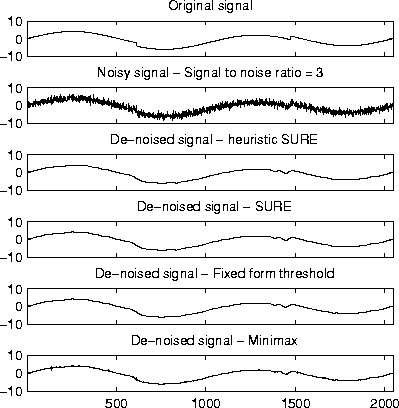
% Set signal to noise ratio and set rand seed.
    snr = 3; init = 2055615866;

% Generate original signal and a noisy version adding
% a standard Gaussian white noise.
    [xref,x] = wnoise(3,11,snr,init);

% De-noise noisy signal using soft heuristic SURE thresholding
% and scaled noise option, on detail coefficients obtained
% from the decomposition of x, at level 5 by sym8 wavelet.
    lev = 5;
    xd = wden(x,'heursure','s','one',lev,'sym8');

% Plot signals.
    subplot(611), plot(xref), axis([1 2048 -10 10]);
    title('Original signal');
    subplot(612), plot(x), axis([1 2048 -10 10]);
    title(['Noisy signal - Signal to noise ratio = ',...
    num2str(fix(snr))]);
    subplot(613), plot(xd), axis([1 2048 -10 10]);
    title('De-noised signal - heuristic SURE');

% De-noise noisy signal using soft SURE thresholding
    xd = wden(x,'heursure','s','one',lev,'sym8');

% Plot signal.
    subplot(614), plot(xd), axis([1 2048 -10 10]);
    title('De-noised signal - SURE');

% De-noise noisy signal using fixed form threshold with
% a single level estimation of noise standard deviation.
    xd = wden(x,'sqtwolog','s','sln',lev,'sym8');

% Plot signal.
    subplot(615), plot(xd), axis([1 2048 -10 10]);
    title('De-noised signal - Fixed form threshold');

% De-noise noisy signal using minimax threshold with
% a multiple level estimation of noise standard deviation.
    xd = wden(x,'minimaxi','s','sln',lev,'sym8');

% Plot signal.
    subplot(616), plot(xd), axis([1 2048 -10 10]);
    title('De-noised signal - Minimax');

% If many trials are necessary, it is better to perform
% decomposition once and threshold it many times:
    % decomposition.
    [c,l] = wavedec(x,lev,'sym8');
    % threshold the decomposition structure [c,l].
    xd = wden(c,l,'minimaxi','s','sln',lev,'sym8');
See Also
thselect, wavedec, wdencmp, wfilters, wthresh
References
A. Antoniadis, G. Oppenheim, Eds. (1995), "Wavelets and statistics," 103,
Lecture Notes in Statistics, Springer Verlag.
D.L. Donoho (1993), "Progress in wavelet analysis and WVD: a ten minute tour," in Progress in wavelet analysis and applications, Y. Meyer, S. Roques, pp. 109-128. Frontières Ed.
D.L. Donoho, I.M. Johnstone (1994), "Ideal spatial adaptation by wavelet shrinkage," Biometrika, vol 81, pp. 425-455.
D.L. Donoho (1995), "De-noising by soft-thresholding," IEEE Trans. on Inf. Theory, 41, 3, pp. 613-627.
D.L. Donoho, I.M. Johnstone, G. Kerkyacharian, D. Picard (1995), "Wavelet shrinkage: asymptotia," Jour. Roy. Stat. Soc., series B, vol. 57, no. 2, pp. 301-369.
[ Previous | Help Desk | Next ]
 . The median absolute deviation of the coefficients is a robust estimate of
  . The use of a robust estimate is crucial for two reasons. The first is that if level 1 coefficients contain f details, these details are concentrated in few coefficients. The second reason is to avoid signal end effects, which are pure artifacts due to computations on the edges.
 level by level. This estimation is implemented in M-file