Meyer wavelet.
Syntax
[PHI,PSI,T] = meyer(LOWB,UPPB,N)
[PHI,T] = meyer(LOWB,UPPB,N,'phi')
[PSI,T] = meyer(LOWB,UPPB,N,'psi')
Description
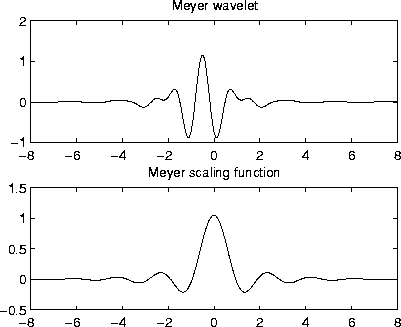
[PHI,PSI,T] = meyer(LOWB,UPPB,N) returns Meyer wavelet and scaling functions evaluated on an N point regular grid on the interval [LOWB,UPPB].
N must be a power of two.
Output arguments are the scaling function PHI and the wavelet function PSI computed on the grid T. These functions have [-8 8] as effective support.
A fourth argument is allowed if only one function is required:
[PHI,T] = meyer(LOWB,UPPB,N,'phi')
[PSI,T] = meyer(LOWB,UPPB,N,'psi')
when the fourth argument is used but not equal to 'phi' or 'psi'. Outputs are the same as in the main option.
The Meyer wavelet and scaling function are defined in the frequency domain by:
where

By changing the auxiliary function (see meyeraux), you get a family of different wavelets. For the required properties of the auxiliary function  , see References in Chapter 6.
Examples
% Set effective support and grid parameters.
    lowb = -8; uppb = 8; n = 1024;

% Compute and plot Meyer wavelet and scaling function.
    [phi,psi,x] = meyer(lowb,uppb,n);
    subplot(211), plot(x,psi)
    title('Meyer wavelet')
    subplot(212), plot(x,phi)
    title('Meyer scaling function')
Algorithm
Starting from an explicit form of the Fourier transform  of
of  ,
, meyer computes the values of  on a regular grid and then the values of are computed using
 instdfft, the inverse nonstandard discrete FFT.
The procedure for  is along the same lines.
See Also
meyeraux, wavefun, waveinfo
References
I. Daubechies (1992), "Ten lectures on wavelets," CBMS-NSF conference series in applied mathematics. SIAM Ed. pp 117-119, 137, 152.
[ Previous | Help Desk | Next ]





