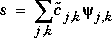
Biorthogonal wavelet filter set.
Syntax
[LO_D,HI_D,LO_R,HI_R] = biorfilt(DF,RF)
[LO_D1,HI_D1,LO_R1,HI_R1,LO_D2,HI_D2,LO_R2,HI_R2] =
biorfilt(DF,RF,'8')
Description
The biorfilt command returns either four or eight filters associated with biorthogonal wavelets.
[LO_D,HI_D,LO_R,HI_R] = biorfilt(DF,RF) computes four filters associated with the biorthogonal wavelet specified by decomposition filter DF and reconstruction filter RF. These filters are:
LO_D
|
Decomposition low-pass filter
|
HI_D
|
Decomposition high-pass filter
|
LO_R
|
Reconstruction low-pass filter
|
HI_R
|
Reconstruction high-pass filter
|
[LO_D1,HI_D1,LO_R1,HI_R1,LO_D2,HI_D2,LO_R2,HI_R2] = biorfilt(DF,RF,'8') returns eight filters, the first four associated with the decomposition wavelet, and the last four associated with the reconstruction wavelet.
It is well known in the sub-band filtering community that if the same FIR filters are used for reconstruction and decomposition, then symmetry and exact reconstruction are incompatible (except with the Haar wavelet). Therefore, with biorthogonal filters, two wavelets are introduced instead of just one:
Further, the two wavelets are related by duality in the following sense:

as soon as  or
or  and
and
 as soon as
  .
It becomes apparent, as A. Cohen pointed out in his thesis (p. 110), that "the useful properties for analysis (e.g., oscillations, null moments) can be concentrated in the
.
It becomes apparent, as A. Cohen pointed out in his thesis (p. 110), that "the useful properties for analysis (e.g., oscillations, null moments) can be concentrated in the  function whereas the interesting properties for synthesis (regularity) are assigned to the
  function. The separation of these two tasks proves very useful."
 and can have very different regularity properties, being more regular than
  (see Daubechies p. 269).
The
(see Daubechies p. 269).
The  , ,
, ,  and
and  functions are zero outside a segment.
Examples
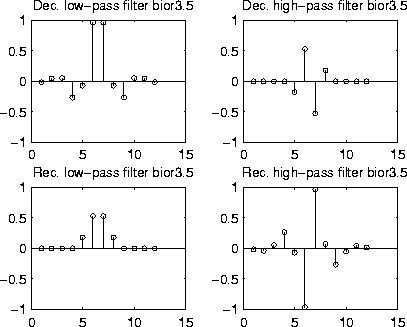
% Compute the four filters associated with spline biorthogonal
% wavelet 3.5: bior3.5.

% Find the two scaling filters associated with bior3.5.
[Rf,Df] = biorwavf('bior3.5');
% Compute the four filters needed.
[Lo_D,Hi_D,Lo_R,Hi_R] = biorfilt(Df,Rf);
subplot(221); stem(Lo_D);
title('Dec. low-pass filter bior3.5');
subplot(222); stem(Hi_D);
title('Dec. high-pass filter bior3.5');
subplot(223); stem(Lo_R);
title('Rec. low-pass filter bior3.5');
subplot(224); stem(Hi_R);
title('Rec. high-pass filter bior3.5');
% Orthogonality by dyadic translation is lost.
    nzer = [Lo_D 0 0]*[0 0 Lo_D]'
nzer =
    -0.6881
    nzer = [Hi_D 0 0]*[0 0 Hi_D]'
nzer =
    0.1875

% But using duality we have:
    zer = [Lo_D 0 0]*[0 0 Lo_R]'
zer =
    -2.7756e-17
    zer = [Hi_D 0 0]*[0 0 Hi_R]'

zer =
    2.7756e-17

% But perfect reconstruction via DWT is preserved.
    x = randn(1,500);
    [a,d] = dwt(x,Lo_D,Hi_D);
    xrec = idwt(a,d,Lo_R,Hi_R);
    err = norm(x-xrec)
err =
    5.0218e-15
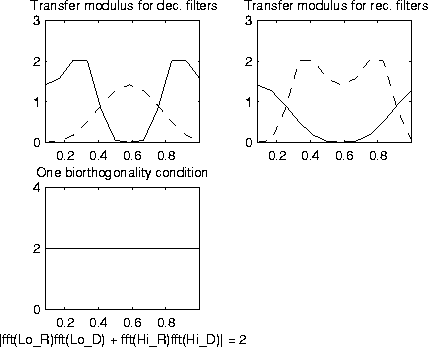
% High and low frequency illustration.
    fftld = fft(Lo_D); ffthd = fft(Hi_D);
    freq = [1:length(Lo_D)]/length(Lo_D);
    subplot(221); plot(freq,abs(fftld),freq,abs(ffthd));
    title('Transfer modulus for dec. filters')
    fftlr = fft(Lo_R); ffthr = fft(Hi_R);
    freq = [1:length(Lo_R)]/length(Lo_R);
    subplot(222); plot(freq,abs(fftlr),freq,abs(ffthr));
    title('Transfer modulus for rec. filters')
    subplot(223); plot(freq, abs(fftlr.*fftld + ffthd.*ffthr));
    title('One biorthogonality condition')
    xlabel('|fft(Lo_R)fft(Lo_D) + fft(Hi_R)fft(Hi_D)| = 2')
 Note: For biorthogonal wavelets, the filters for decomposition and reconstruction are in general of different odd lengths. This situation occurs, for example, for "splines" biorthogonal wavelets used in the toolbox, where the four filters are zero-padded to have the same even length.
See Also
biorwavf, orthfilt
References
A. Cohen (1992) "Ondelettes, analyses multirésolution et traitement numérique du signal," Ph. D. Thesis, University of Paris IX, DAUPHINE.
I. Daubechies (1992), "Ten lectures on wavelets," CBMS-NSF conference series in applied mathematics. SIAM Ed.
[ Previous | Help Desk | Next ]
 , is used in the analysis, and the coefficients of a signal s are
  ,
,