| Using Stateflow | Search Help Desk |
Default Transitions
Example: Default Transition in an Exclusive (OR) Decomposition
This example shows a transition from an OR state to a superstate with exclusive (OR) decomposition, where a default transition to a substate is defined.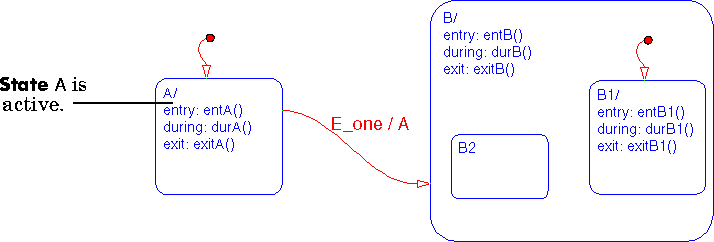
A is active. Event E_one occurs and awakens the Stateflow diagram. Event E_one is processed from the root of the Stateflow diagram down through the hierarchy of the Stateflow diagram:
E_one. There is a valid transition from state A to superstate B.
A exit actions execute and complete (exitA()).
A is marked inactive.
A, is executed and completed.
B is marked active.
B entry actions execute and complete (entB()).
B detects a valid default transition to state B.B1.
B.B1 is marked active.
B.B1 entry actions execute and complete (entB1()).
E_one.
Example: Default Transition to a Junction
This example shows the semantics of a default transition to a connective junction.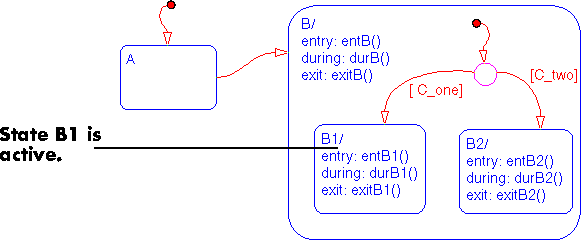
B.B1 is active. An event occurs and awakens the Stateflow diagram. Condition [C_two] is true. The event is processed from the root of the Stateflow diagram down through the hierarchy of the Stateflow diagram:
B checks to see if there is a valid transition as a result of any event.
There is none.
B1 during actions execute and complete (durB1()).
Example: Default Transition and a History Junction
This example shows the semantics of a superstate and a history junction.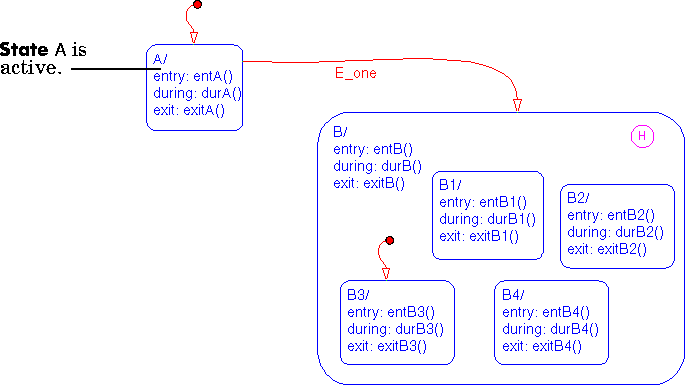
A is active. There is a history junction and state B4 was the last active substate of superstate B. Event E_one occurs and awakens the Stateflow diagram. Event E_one is processed from the root of the Stateflow diagram down through the hierarchy of the Stateflow diagram:
E_one. There is valid transition from state A to superstate B.
A exit actions execute and complete (exitA()).
A is marked inactive.
B is marked active.
B entry actions execute and complete (entB()).
B detects and uses the history junction to determine which substate is
the destination of the transition into the superstate. The history junction
indicates substate B.B4 was the last active substate, and thus the
destination of the transition.
B.B4 is marked active.
B.B4 entry actions execute and complete (entB4()).
E_one.
Example: Labeled Default Transitions
This example shows the use of a default transition with a label.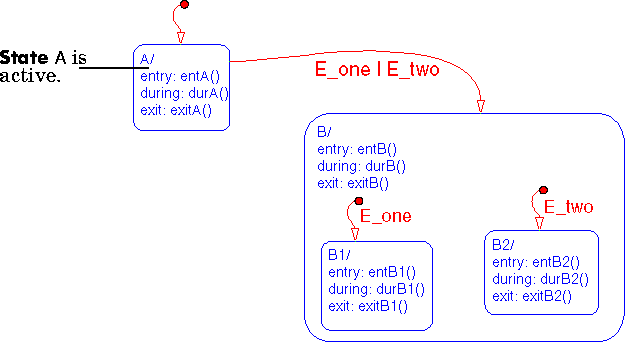
A is active. Event E_one occurs awakening the Stateflow diagram. Event E_one is processed from the root of the Stateflow diagram down through the hierarchy of the Stateflow diagram:
E_one. There is a valid transition from state A to superstate B. A
pipe is used to represent that the transition is valid if event E_one or E_two
occurs.
A exit actions execute and complete (exitA()).
A is marked inactive.
B is marked active.
B entry actions execute and complete (entB()).
B detects a valid default transition to state B.B1. The default transition
is valid as a result of E_one.
B.B1 is marked active.
B.B1 entry actions execute and complete (entB1()).
E_one.