| Spline Toolbox | Search Help Desk |
| spaps | Examples See Also |
Syntax
sp = spaps( x,y,tol)[sp, values] = spaps(x,y,tol,arg1,arg2)
Description
Returns the smoothest function that lies within the given tolerancetol of the given data and, optionally, its values at the given x.
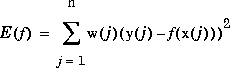
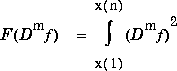
Here, smoothest means that the following measure of roughness is minimized:Further, the distance of the function f from the given data is measured by
The default value for m is 2, leading to the cubic smoothing spline. However, the choices m=1 and m=3, for the linear, respectively the quintic, smoothing spline are available, too, by setting one of the optional inputs argi equal to 1 or 3. Further, the default value for the weight vector w makes E(f) the composite trapezoidal rule approximation to

but the weight vector may also be supplied as one of the optional inputs argi (as a positive vector of the same length as x).
x is not increasing, then both x and y (as well as w if given) will be re-ordered in unison to make x increasing. After that, x must be strictly increasing.
The data being fitted may be d-vector-valued, and this is indicated by having y be of size [d,n]. In this case, both the measure of roughness and the distance of the (d-vector-valued) function f from the data are the sum of the componentwise measures. For example, if f(x) is the d-vector (f1(x), ...,fd(x)), then E(f) = E(f1) + ... + E(fd).
It is also possible to obtain a smoothing spline for gridded data. When x is a cell array of length r, then y is expected to supply the corresponding gridded values, with size(y) equal to [length(x{1}),...,length(x{r})] in case the function is scalar-valued, and equal to [d,length(x{1}),...,length(x{r})] in case the function is d-vector-valued. Further, the optional input for m must be an r-vector (with entries from the set {1,2,3}), and the optional argument for w must be a cell array of length r, with w{i} either empty (to indicate that the default choice is wanted) or else a positive vector of the same length as x{i}.
Examples
The statementsw = ones(size(x)); w([1 end]) = 100;
sp = spaps(x,y, 1.e-2, w, 3);
give a quintic smoothing spline approximation to the given data that close to interpolates the first and last datum, while being within about 1.e-2 of the rest.
Algorithm
Reinsch's approach [1] is used (including his clever way of choosing the equation for the optimal smoothing parameter in such a way that a good initial guess is available and Newton's method is guaranteed to converge and to converge fast).See Also
spap2, spapi, csaps
References
[1] C. Reinsch, Smoothing by spline functions, Numer. Math. 10 (1967), 177-183.