| Signal Processing Toolbox | Search Help Desk |
| rlevinson | See Also |
Reverse Levinson-Durbin recursion.
Syntax
r = rlevinson(a,efinal)
[r,u] = rlevinson(a,efinal)
[r,u,k] = rlevinson(a,efinal)
[r,u,k,e] = rlevinson(a,efinal)
Description
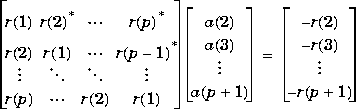
The reverse Levinson-Durbin recursion implements the step-down algorithm for solving the following symmetric Toeplitz system of linear equations for r, where r =[r(1) ... r(p+1)] and r(i)* denotes the complex conjugate of r(i).
r = rlevinson(a,efinal)
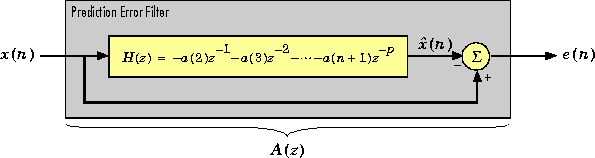
solves the above system of equations for r given vector a, where a = [1 a(2) ... a(p+1)]. In linear prediction applications, r represents the autocorrelation sequence of the input to the prediction error filter, where r(1) is the zero-lag element. The figure below shows the typical filter of this type, where H(z) is the optimal linear predictor, x(n) is the input signal,  is the predicted signal, and e(n) is the prediction error.
 Input vector
 a represents the polynomial coefficients of this prediction error filter in descending powers of z

efinal is the scalar prediction error power, which is equal to the variance of the prediction error signal,  2(e).
2(e).
[r,u] = rlevinson(a,efinal)
returns upper triangular matrix U from the UDU* decomposition

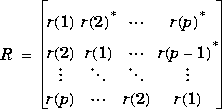
e (see below). This decomposition permits the efficient evaluation of the inverse of the autocorrelation matrix, R-1.
Output matrix u contains the prediction polynomial, a, from each iteration of the reverse Levinson-Durbin recursion
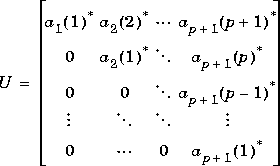
a5 = u(5:-1:1,5)'Note that
u(p+1:-1:1,p+1)' is the input polynomial coefficient vector a.
[r,u,k] = rlevinson(a,efinal)
returns a vector k of length (p+1) containing the reflection coefficients. The reflection coefficients are the conjugates of the values in the first row of u
k = conj(u(1,2:end))
[r,u,k,e] = rlevinson(a,efinal)
returns a vector of length (p+1) containing the prediction errors from each iteration of the reverse Levinson-Durbin recursion: e(1) is the prediction error from the first-order model, e(2) is the prediction error from the second-order model, and so on.
These prediction error values form the diagonal of the matrix E in the UDU* decomposition of R-1,
 .
.
See Also
levinson |
Levinson-Durbin recursion. |
lpc |
Linear prediction coefficients. |
prony |
Prony's method for time domain IIR filter design. |
stmcb |
Linear model using Steiglitz-McBride iteration. |
References
[1] Kay, S.M. Modern Spectral Estimation: Theory and Application. Englewood Cliffs, NJ: Prentice Hall, 1988.