| Signal Processing Toolbox | Search Help Desk |
| pmtm | Examples See Also |
Power spectrum estimate using the multitaper method (MTM).
Syntax
Pxx = pmtm(x,nw)
Pxx = pmtm(x,nw,nfft)
[Pxx,f] = pmtm(x,nw,nfft,Fs)
[Pxx,f] = pmtm(x,nw,nfft,Fs,'method')
[Pxx,Pxxc,f] = pmtm(x,nw,nfft,Fs,'method')
[Pxx,Pxxc,f] = pmtm(x,nw,nfft,Fs,'method',p)
[Pxx,Pxxc,f] = pmtm(x,e,v,nfft,Fs,'method',p)
[Pxx,Pxxc,f] = pmtm(x,dpss_params,nfft,Fs,'method',p)
Description
pmtm estimates the power spectral density (PSD) of the real time series x using the multitaper method (MTM), described in [1].
Pxx = pmtm(x,nw)
estimates the PSD using nw as the time-bandwidth product for the discrete prolate spheroidal sequences (Slepian sequences) that are used as data windows. The default for nw is 4; other typical choices arePxx is 2*nw-1.
Pxx = pmtm(x,nw,nfft)
defines the frequency grid as length nfft. When x is real, Pxx is length (nfft/2+1) for nfft even and (nfft+1)/2 for nfft odd; when x is complex, Pxx is length nfft. The default for nfft is 256 or the next power of 2 greater than the length of x, whichever is larger.
[Pxx,f] = pmtm(x,nw,nfft,Fs)
returns f, the vector of frequencies at which the PSD is estimated, for the sampling frequency Fs. The default for Fs is 1 Hz.
[Pxx,f] = pmtm(x,nw,nfft,Fs,'method')
specifies the algorithm used for combining the individual spectral estimates, where method is:
adapt, to specify Thomson's adaptive nonlinear combination (default)
unity, to specify a linear combination with unity weights
eigen, to specify a linear combination with eigenvalue weights
[Pxx,Pxxc,f] = pmtm(x,nw,nfft,Fs,'method')
returns Pxxc, the 95% confidence interval for Pxx, and
[Pxx,Pxxc,f] = pmtm(x,nw,nfft,Fs,'method',p)
returns Pxxc, the p*100% confidence interval for Pxx, where p is a scalar between 0 and 1. Confidence intervals are computed using a chi-squared approach, where Pxxc(:,1) is the lower bound and Pxxc(:,2) is the upper bound of the confidence interval.
[Pxx,Pxxc,f] = pmtm(x,e,v,nfft,Fs,'method',p)
returns the PSD estimate Pxx, the confidence interval Pxxc, and the frequency vector f from the data tapers in e and their concentrations v.
[Pxx,Pxxc,f] = pmtm(x,dpss_params,nfft,Fs,'method',p)
returns the PSD estimate Pxx, the confidence interval Pxxc, and the frequency vector f from the data tapers computed using dpss with parameters from the cell array dpss_params, whose first element is the second input to dpss. The first dpss parameter (n) is determined by the length of x. For example, pmtm(x,{3.5,'trace'},512,Fs) calculates the Slepian sequences for nw = 3.5, and displays the method that dpss uses. See dpss for other options.
Remarks
pmtm with no output arguments plots the PSD in the current or next available figure, with confidence intervals.
To use default parameters for any argument in an expression, insert an empty matrix []. For example, pmtm(x,[],[],1000) uses defaults for the second and third elements, in this case, nw and nfft.
Example
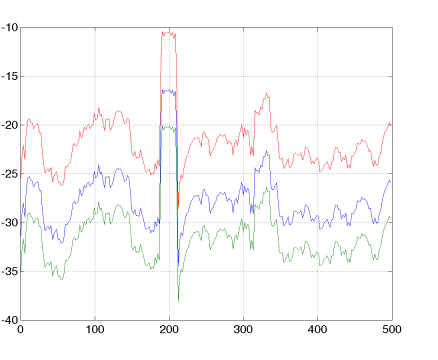
This example analyzes a sinusoid in white noise:Fs = 1000; t = 0:1/Fs:0.3; x = cos(2*pi*t*200) + randn(size(t)); [Pxx,Pxxc,f] = pmtm(x,3.5,512,Fs,[],0.99); plot(f,10*log10([Pxx Pxxc])), grid
See Also
dpss |
Discrete prolate spheroidal sequences (Slepian sequences). |
pburg |
Power spectrum estimate using the Burg method. |
pcov |
Power spectrum estimate using the covariance method. |
pmcov |
Power spectrum estimate using the modified covariance method. |
pmusic |
Power spectrum estimate using MUSIC eigenvector method. |
pwelch |
Estimate the power spectral density (PSD) of a signal using Welch's method. |
pyulear |
Power spectrum estimate using Yule-Walker AR method. |
References
[1] Percival, D.B., and A.T. Walden. Spectral Analysis for Physical Applications: Multitaper and Conventional Univariate Techniques. Cambridge: Cambridge University Press, 1993. [2] Thomson, D.J. "Spectrum estimation and harmonic analysis." In Proceedings of the IEEE. Vol. 70 (1982). Pgs. 1055-1096.