| Signal Processing Toolbox | Search Help Desk |
| maxflat | Examples See Also |
Generalized digital Butterworth filter design.
Syntax
[b,a,] = maxflat(nb,na,Wn)
b = maxflat(nb,'sym',Wn)
[b,a,b1,b2] = maxflat(nb,na,Wn)
[...] = maxflat(nb,na,Wn,'design_flag')
Description
[b,a,] = maxflat(nb,na,Wn)
is a lowpass Butterworth filter with numerator and denominator coefficients b and a of orders nb and na respectively. Wn is the cutoff frequency at which the magnitude response of the filter is equal to  (approx. -3 dB).
 Wn must be between 0 and 1, where 1 corresponds to half the sampling frequency (the Nyquist frequency).
b = maxflat(nb,'sym',Wn)
is a symmetric FIR Butterworth filter. nb must be even, and Wn is restricted to a subinterval of [0,1]. The function raises an error if Wn is specified outside of this subinterval.
[b,a,b1,b2] = maxflat(nb,na,Wn)
returns two polynomials b1 and b2 whose product is equal to the numerator polynomial b (that is, b = conv(b1,b2)). b1 contains all the zeros at z = -1, and b2 contains all the other zeros.
[...] = maxflat(nb,na,Wn,'design_flag')
enables you to monitor the filter design, where design_flag is
trace, for a textual display of the design table used in the design
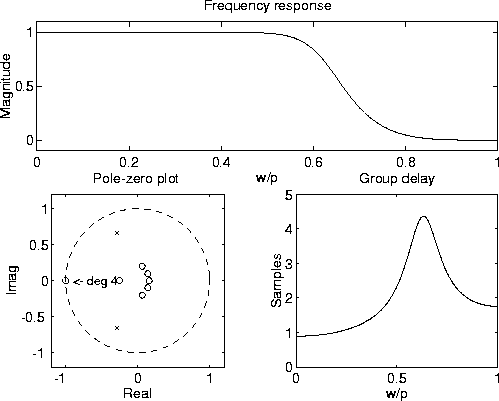
plots, for plots of the filter's magnitude, group delay, and zeros and poles
both, for both the textual display and plots
Examples
nb = 10; na = 2; Wn = 0.2*pi;
[b,a,b1,b2] = maxflat(nb,na,Wn,'plots')
Algorithm
The method consists of the use of formulae, polynomial root finding, and a transformation of polynomial roots.See Also
butter |
Butterworth analog and digital filter design. |
filter |
Filter data with a recursive (IIR) or nonrecursive (FIR) filter. |
freqz |
Frequency response of digital filters. |
References
[1] Selesnick, I.W., and C.S. Burrus. "Generalized Digital Butterworth Filter Design." Proceedings of the IEEE Int. Conf. Acoust., Speech, Signal Processing. Vol. 3 (May 1996).