
| Signal Processing Toolbox | Search Help Desk |
| filtic | See Also |
Find initial conditions for a transposed direct form II filter implementation.
Syntax
z = filtic(b,a,y,x)
z = filtic(b,a,y)
Description
z = filtic(b,a,y,x)
finds the initial conditions z for the delays in the transposed direct form II filter implementation given past outputs y and inputs x. The vectors b and a represent the numerator and denominator coefficients, respectively, of the filter's transfer function.
The vectors x and y contain the most recent input or output first, and oldest input or output last:
nb is length(b)-1 (the numerator order) and na is length(a)-1 (the denominator order). If length(x) is less than nb, filtic pads it with zeros to length nb; if length(y) is less than na, filtic pads it with zeros to length na. Elements of x beyond x(nb-1) and elements of y beyond y(na-1) are unnecessary so filtic ignores them.
Output z is a column vector of length equal to the larger of nb and na. z describes the state of the delays given past inputs x and past outputs y.
z = filtic(b,a,y)
assumes that the input x is 0 in the past.
The transposed direct form II structure is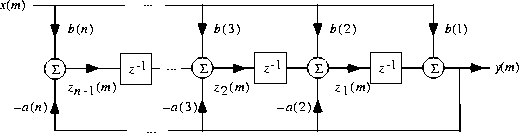
filtic works for both real and complex inputs.
Algorithm
filtic performs a reverse difference equation to obtain the delay states z.
Diagnostics
If any of the input argumentsy, x, b, or a is not a vector (that is, if any argument is a scalar or array), filtic gives the following error message:
Requires vector inputs.
See Also
filter |
Filter data with a recursive (IIR) or nonrecursive (FIR) filter. |
filtfilt |
Zero-phase digital filtering. |
References
[1] Oppenheim, A.V., and R.W. Schafer. Discrete-Time Signal Processing. Englewood Cliffs, NJ: Prentice Hall, 1989. Pgs. 296, 301-302.