
| Signal Processing Toolbox | Search Help Desk |
| fftfilt | Examples See Also |
FFT-based FIR filtering using the overlap-add method.
Syntax
y = fftfilt(b,x)
y = fftfilt(b,x,n)
Description
fftfilt filters data using the efficient FFT-based method of overlap-add, a frequency domain filtering technique that works only for FIR filters.
y = fftfilt(b,x)
filters the data in vector x with the filter described by coefficient vector b. It returns the data vector y. The operation performed by fftfilt is described in the time domain by the difference equation

fftfilt chooses an FFT length and data block length that guarantee efficient execution time.
y = fftfilt(b,x,n)
uses an FFT length of nfft = 2^nextpow2(n) and a data block length of nfft - length(b) + 1.
fftfilt works for both real and complex inputs.
Example
Show that the results fromfftfilt and filter are identical:
b = [1 2 3 4];
x = [1 zeros(1,99)]';
norm(fftfilt(b,x) - filter(b,1,x))

ans =
    9.5914e-15
Algorithm
fftfilt uses fft to implement the overlap-add method [1], a technique that combines successive frequency domain filtered blocks of an input sequence. fftfilt breaks an input sequence x into length L data blocks:
b by
y = ifft(fft(x(i:i+L-1),nfft).*fft(b,nfft));where
nfft is the FFT length. fftfilt overlaps successive output sections by nb-1 points, where nb is the length of the filter, and sums them: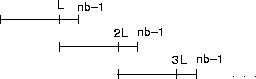
fftfilt chooses the key parameters L and nfft in different ways, depending on whether you supply an FFT length n and on the lengths of the filter and signal. If you do not specify a value for n (which determines FFT length), fftfilt chooses these key parameters automatically:
length(x) > length(b), fftfilt chooses values that minimize the number of blocks times the number of flops per FFT.
length(b) >= length(x), fftfilt uses a single FFT of length
2^nextpow2(length(b) + length(x) - 1)
This essentially computes
y = ifft(fft(B,nfft).*fft(X,nfft))If you supply a value for
n, fftfilt chooses an FFT length, nfft, of 2^nextpow2(n)and a data block length of nfft - length(b) + 1. If n is less than length(b), fftfilt sets n to length(b).
See Also
conv |
Convolution and polynomial multiplication. |
filter |
Filter data with a recursive (IIR) or nonrecursive (FIR) filter. |
filtfilt |
Zero-phase digital filtering. |
References
[1] Oppenheim, A.V., and R.W. Schafer. Discrete-Time Signal Processing. Englewood Cliffs, NJ: Prentice Hall, 1989.