Left and right spectral factorization.
Syntax
[am,bm,cm,dm] = sfl(a,b,c,d)
[am,bm,cm,dm] = sfr(a,b,c,d)
[ssm] = sfl(ss)
[ssm] = sfr(ss)
Description
Given a stabilizable realization of a transfer function G(s) := (A, B, C, D) with  ,
, sfl computes a left spectral factor M(s) such that where M(s) := (AM, BM, CM, DM) is outer (i.e., stable and minimum-phase).
Sfr computes a right spectral factor M(s) of G(s) such that
Algorithm
Given a transfer function G(s) := (A, B, C, D), the LQR optimal control
u = -Fx = -R-1(XB + N)Tx stabilizes the system and minimize the quadratic cost function
 as
as  satisfies the algebraic Riccati equation
 Moreover, the optimal return difference I + L(s) = I + F(Is - A) -1B satisfies the optimal LQ return difference equality:
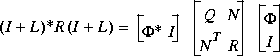 where
where  (s) = (Is - A)-1B, and *(s) = T(-s). Taking
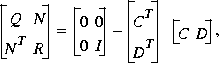 the return difference equality reduces to
  so that a minimum phase, but not necessarily stable, spectral factor is
 where X and F can simply be obtained by the command:
[F,X] = lqr(A,B,Q,R,N) =
lqr(A,B,-C'*C,(I-D'*D),-C'*D).
Finally, to get the stable spectral factor, we take M(s) to be the inverse of the
outer factor of  . The routine
 iofr is used to compute the outer factor.
Limitations
The spectral factorization algorithm employed in sfl and sfr requires the system G(s) to have  and to have no
  -axis poles. If the condition
  fails to hold, the Riccati subroutine (
aresolv) will normally produce the message
WARNING: THERE ARE j -AXIS POLES...
RESULTS MAY BE INCORRECT !!
-AXIS POLES...
RESULTS MAY BE INCORRECT !!
This happens because the Hamiltonian matrix associated with the LQR optimal control problem has j-axis eigenvalues if and only if  . An interesting implication is that you could use
 sfl or sfr to check whether  without the need to actually compute the singular value Bode plot of G(j).
See Also
iofc, iofr
[ Previous | Help Desk | Next ]